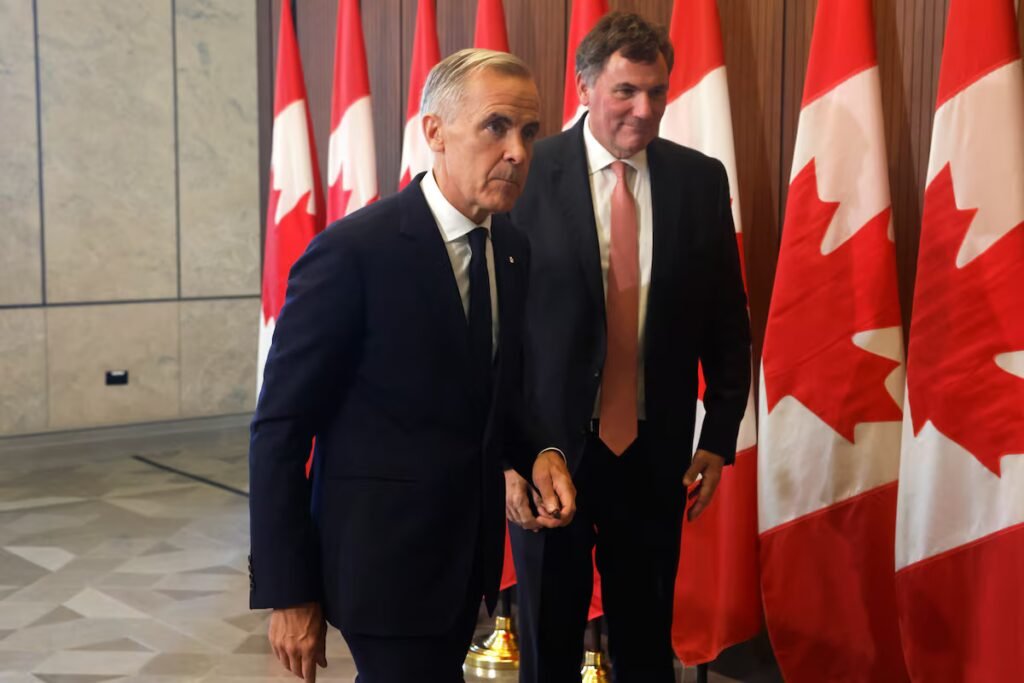

Prime Minister Mark Carney and Canada-U.S. Trade Minister Dominic LeBlanc leave a news conference about Canada’s response to new U.S. tariffs on Parliament Hill in Ottawa on Aug. 22.PATRICK DOYLE/The Canadian Press
Paolo Gentiloni, a former Italian prime minister who later served as the European Union’s economy commissioner, was the lone, high-profile politician I could find anywhere on the continent to cheer on Mark Carney’s refusal to capitulate to Donald Trump. Last Saturday, after Mr. Carney said Canada was “under attack” by the Trump White House and that he could never accept Mr. Trump’s sovereignty robbing trade demands, Mr. Gentiloni said, “Here is the speech I would like to hear in Europe.”
He might have to wait a few years for the politicians’ backbones to form.
Not a single president or prime minister in the 27-country European Union raised their fists in the air for Mr. Carney. How did you explain that, given that it’s an open secret that most of them consider Mr. Trump a volatile bully? Even far-right Italian Prime Minister Giorgia Meloni – the EU’s “Trump whisperer” – has turned on the man (“As for my popularity, being your friend has certainly not helped it,” she told Mr. Trump on social media in June).
The simple answer is that they feared provoking Mr. Trump and his henchmen – Howard Lutnick, Jamieson Greer, JD Vance, among others. They would rather live with the lopsided trade deal they reluctantly accepted last year than see Mr. Trump fly into a rage and replace it with nastier one. Ditto Japan, South Korea and Britain. Their leaders shake Mr. Trump’s hand while gritting their teeth.
Mr. Carney seems all alone in the trade world, tilting at Mr. Trump’s tariffs fortress. But appearances can be deceptive. Even though EU leaders will not publicly join his anti-Trump crusade, they are endorsing him in more subtle ways. Evidence came on Wednesday, when the prime minister’s office said that he will attend the EU’s State of the Union address to be given by EU President Ursula von der Leyen on Sept. 16 in Strasbourg.
The next day, he will address the EU parliament. It’s impossible to imagine that Mr. Trump would receive the same invitation (the last U.S. president to address the parliament was Ronald Reagan, in 1985). Canada’s attempted pivot to Europe is building momentum, doubly so after Mr. Trump hit Canada with 50 per cent tariffs on a broad range of goods on Saturday. “My sense is that there is a lot of international respect for Carney standing up to Trump even if there is reluctance of foreign leaders to come out with full-voice support for him,” said Canadian international trade lawyer Lawrence Herman.
The new Trump onslaught will hurt Canada, especially if an escalating tariff war breaks out. Economic pain is a certainly; its intensity is the only question. Mr. Carney did what he had to do. His mistake was not realizing long ago that Canada was in a no-win situation and that the president was not motivated by economic sanity, but by spite. Perhaps Mr. Trump never forgave Mr. Carney for his Davos speech in January, when he said the U.S.-led rules-based order was breaking down. “We are in the midst of a rupture, not a transition,” he said at the economic forum.
The first clue that Mr. Trump considered Canada more foe that friend came way back in his first term as president (Mr. Carney was then governor of the Bank of England). In 2018, he slapped Canada with 25 per cent tariffs on steel and 10 per cent on aluminum. Canada responded with retaliatory tariffs. Last year, within weeks of his entering the White House for the second time, he hit Canada with a new round of steel and aluminum tariffs, citing spurious national security concerns. Canada once again responded in kind.
Mr. Carney became prime minister in March, 2025. That’s when the embrace of Europe and other economies should have begun with vengeance, all the more so since the auto tariffs unleashed by Mr. Trump stood to cripple the largely Ontario-based auto industry. Canada is highly unlikely to attract new investments in auto or electric-vehicle battery plants as long as Mr. Trump and his trade-wrecking machine are in place. It has been a race to the bottom of the diplomacy barrel since then. The Canada-U.S. relationship turned petulant when Mr. Trump fired off calls to turn Canada into the “51st state,” and again on Thursday when he used an executive order to rename Lake Ontario “Lake America.”
Canada has already made some progress in downgrading the U.S. as a trade partner and embracing Europe, especially on the defence front. It recently ordered a dozen attack submarines from Germany’s ThyssenKrupp, airborne early-warning planes from Sweden’s Saab and over-the-horizon radar from Australia. It has started negotiations to buy Italian-made M-346 jet trainers. The likelihood of Canada buying – and building – Sweden’s Saab Gripen fighter jet got a big boost when Mr. Trump ramped up his trade war against Canada last week. Why reward him by buying more U.S.-made F-35 fighter jets?
There are so many more areas where Canada and Europe could increase their ties, from liquefied natural gas and critical metals to aerospace components and fertilizer. It will happen, perhaps more slowly than Canada wants – but it will happen. The world needs what Canada has in abundance in the ground. Canada will be rewarded, not with cheers, but with contracts.


More Stories
Diana Fox Carney makes first trip to Halifax as Ocean Envoy ahead of international conference she will chair
Trump’s diesel deal with Putin is Russian roulette
H&R REIT CEO’s investor role in proposed takeover deal draws opposition