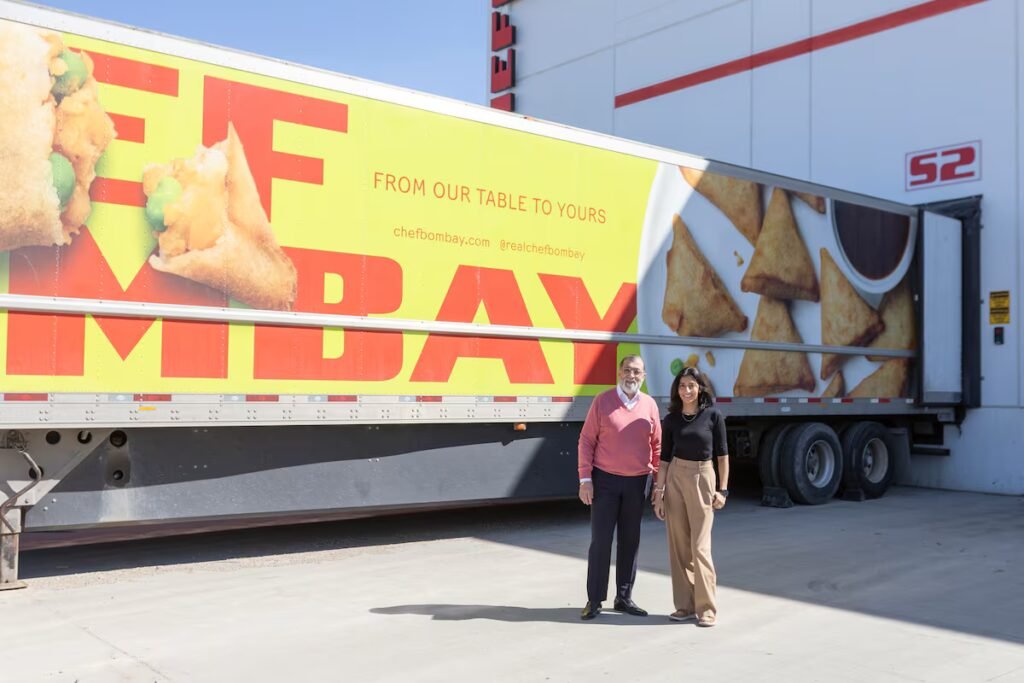

Noorudin Jiwani, president and CEO of Aliya’s Foods, and his daughter Khadija Jiwani, chief operating officer, at the Indian frozen-food manufacturer’s 100,000-square-foot facility just south of Edmonton.Megan Albu/The Globe and Mail
Noorudin Jiwani was initially skeptical of the new ideas his daughter Khadija Jiwani wanted to introduce at Aliya’s Foods, the Indian frozen-foods manufacturer he founded with his wife in 1999.
On the one hand, Khadija’s decision to join the Edmonton-based family business in 2015 “was the best day of my life,” says Noorudin, Aliya’s president and CEO. He’d been thinking about retirement and was keen for one of his children to take over. On the other hand, he found it hard to relinquish control.
It’s a sentiment that’s familiar to entrepreneurs contemplating the next phase of their enterprise and a challenge for successors trying to establish themselves as leaders, according to Dana McCauley, CEO of the not-for-profit Canadian Food Innovation Network, which supports the growth of food businesses. “Letting go, whether the succession is to another family member or to a hired CEO, can be very, very difficult on an emotional level for the founder,” she says.
In Noorudin’s case, he felt a push-pull tension early on – a desire to bring Khadija in, coupled with a reluctance to adopt new ways of doing business. “The first few months were difficult when she wanted to change things,” Noorudin, 68, admits. But the situation quickly got better “once she proved what she was capable of doing in the first few months – I’ve never looked back.”
Khadija brought to the company a fresh perspective with her civil engineering and MBA degrees, an interest in design and experience in construction project management and in international development.
While she didn’t have a formal role at first, she helped with tasks that filled gaps in the enterprise, mostly related to marketing, operations and strategy. The company’s core business was from private-label orders – primarily with major grocery chains. It also had an in-house line, Chef Bombay, that supplied about 100 stores with frozen samosas, pakoras and meals such as butter chicken and beef vindaloo.
Khadija first spearheaded a brand refresh that got attention from the right places. “People started bringing us on to trade shows and they were stopping at our booth,” she says.
By 2016, Loblaws agreed to carry the brand. Chef Bombay is now available in more than 7,000 stores in Canada and the United States, where 85 per cent of Aliya’s products are sold. The company is launching a second frozen-food line, focused on Mexican-American products, this fall and will add about 100 employees to its current staff of about 400. It is also expanding its manufacturing footprint to 150,000 square feet, from 100,000 square feet, with a new facility focused on automation.
Another early win was Khadija’s idea to renovate the company’s administrative space – which she saw as being too closed off and siloed – into a more open-concept office with room to grow.
“It changed communication so drastically that nothing was falling between the cracks,” Noorudin says. “At that point, I saw the proof. She had proven herself.”
Noorudin and Khadija in Aliya’s Foods’ spice room. When the trade war with the United States presented a major challenge last year, the company found new suppliers in Canada and India for key ingredients such as chicken and spices that it had previously sourced south of the border.Megan Albu/The Globe and Mail
Khadija was 13 when her mother Anis Jiwani, a registered dietician, fulfilled a dream of opening her own food company by launching Aliya’s Foods (named after their younger daughter) with Noorudin. With their Indian roots, the couple saw a gap in the Canadian market for frozen Indian snacks and meals. Anis, originally from Uganda, started making samosas under the Chef Bombay name. Noorudin, who is originally from Kenya, had previously worked in consulting and was pursuing a career as an actuary when they started the firm.
Though both kids had summer jobs in the family business cutting produce, assembling boxes and photocopying, Khadija, 39, says, “When I was younger, I was very adamant – I was like, ‘I’m not working here. I’m going to do my own thing.’”
That changed when she returned to Canada after a stint overseas at a non-governmental organization and realized she could make a difference through Aliya’s too. For instance, Khadija continues her parents’ practice of frequently hiring staff without a Canadian work history because the family is acutely aware of the discrimination that newcomers face seeking employment in Canada.
The Jiwanis are taking a gradual, ad hoc approach to succession based on the skills and interests of the next generation. Khadija assumed her current position of chief operating officer in 2023. She says that company roles for her “relationship-oriented” cousin Hafiz Jiwani as vice-president of sales, and in employee training and education for her sister – a former teacher and school principal – emerged from natural fits to each individual’s personality and their strengths.
Noorudin still oversees the finances while Anis continues to have a say in recipe development. They also stepped in early last year, when the trade war with the U.S. presented a major challenge, to help find new suppliers in Canada and India for key ingredients such as chicken and spices that were previously sourced south of the border.
The plan is for Noorudin to eventually step back officially and to chair the company’s board so that Khadija can take over as CEO. While Khadija’s background and interests align most with the chief executive role, she says she frequently makes decisions with Hafiz, Aliya and the broader leadership team.
Ms. McCauley says that organic approach to succession is untraditional but can work with the right mix of people. “It’s interesting because you generally hire somebody the opposite way, based on what the company needs,” Ms. McCauley says. “But you need to seal up the gaps that will be left by the person who’s transitioning out” when taking a less structured route.
For Khadija, becoming CEO will be the ultimate full circle. Her earlier NGO work stemmed from a desire for her career to have meaning. “I want to make a difference in the world,” she explains.
She now sees that she can do that within the business her parents started. “Recognizing what they had put together and what they were able to do … I realized that I can have an impact here, too.”


More Stories
NATO innovation exercise puts emerging defence technologies to the test in Nova Scotia
Canadian housing policy wants you to live in shoebox condos in the middle of nowhere
Russia and Ukraine reach energy ceasefire, Trump says