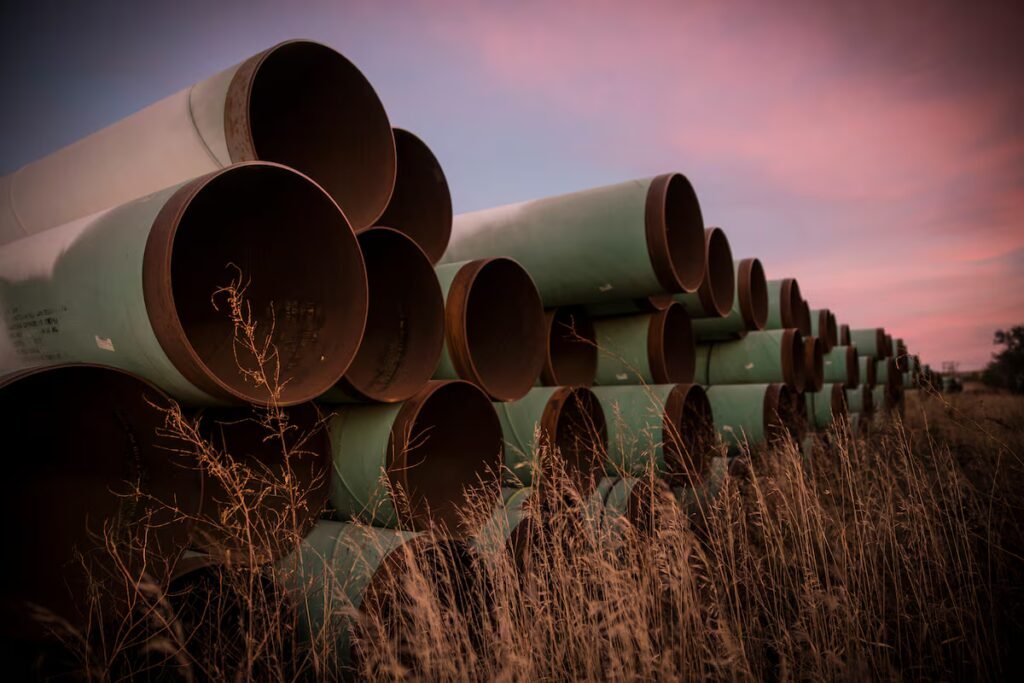

Miles of unused pipe, prepared for the proposed Keystone XL pipeline, sit in a lot in October, 2014, outside Gascoyne, N.D.Andrew Burton/Getty Images
News of Keystone XL’s rebirth may be slightly exaggerated.
U.S. President Donald Trump said late Tuesday that the ill-fated pipeline proposal – a flashpoint in the debate about the impact of fossil-fuel use on climate change – could be resurrected as part of a trade deal with Canada.
Mr. Trump brought the Canada-to-U.S. pipeline up in a social-media post announcing that he had postponed slapping tariffs on US$20-billion worth of Canadian goods for three days to allow negotiators to finalize a trade agreement.
Mr. Trump wrote that the pipeline “may be awoken from the grave!” and included an AI-generated image of himself pulling it up from the ground. He also took a jab at former president Joe Biden, who rescinded the presidential permit for Keystone XL as one of his first orders after taking office in 2021.
U.S. and Canadian officials offered no further details.
However, a proposal that loosely follows parts of the previous Keystone XL route is well under way, with final investment decisions planned for the middle of next year. In fact, Mr. Trump has issued a permit for the U.S. partner in that development.
New U.S. proposal could revive Keystone XL pipeline assets, but would need Trump’s approval
Analysts were highly skeptical on Wednesday that Keystone XL could be reborn in its previous form. TC Energy Corp. proposed the massive project in 2008 and finally cancelled it in 2021.
It “would be completely out of the blue and make little immediate sense to literally reanimate KXL, given the work done on the other projects thus far,” said Rory Johnston, oil analyst and founder of Commodity Context, an oil market research platform.
In addition, oil markets have evolved since that project was proposed nearly two decades ago, he said.
Indeed, there are now numerous options to move Canadian crude oil across the continent, after a series of capacity expansions. In addition, refineries in the U.S. Gulf Coast do not have the same level of demand for heavy crude oil – the type produced in large quantities in Canada – as in 2008. “That was already true before the ‘liberation’ of Venezuela, and now even more so,” Mr. Johnston said.
Opinion: What’s on the table? Trump’s talk doesn’t sound quite like Canada’s
TC Energy TRP-T, then known as TransCanada Corp., sought to build a pipeline extending to the southern U.S. and Gulf Coast regions from Alberta, carrying 830,000 barrels of oil a day. Faced with regulatory delays in the U.S., the company built the southern leg, aiming to finish the rest of the conduit between the Canada-U.S. border and Steele City, Neb., later.
After years of protests, studies, court challenges, presidential rejections and approvals – even an attempt by the Alberta government to push it forward by gaining an equity stake – the company ended its quest five years ago.
Last October, The Globe and Mail and other media reported that Prime Minister Mark Carney had raised the prospect of reviving Keystone XL during a meeting with Mr. Trump at the White House.
Since then, South Bow Corp. SOBO-T, a spinoff from TC Energy, proposed the Prairie Connector pipeline, some of which would use pipe that was constructed in Canada for Keystone XL. The 550,000-barrel-a-day line would run to the Canada-U.S. border and link up with a line proposed by Bridger Pipeline LLC. From there, it would carry crude to Guernsey, Wyo., and have access to the hub in Cushing, Okla.
Mr. Trump granted a permit for the Bridger portion in April, giving the company permission to construct, connect, operate and maintain pipeline facilities at the border.
This month, South Bow chief executive officer Bevin Wirzba said the company expects to make a final investment decision on Prairie Connector by mid-2027 after it had secured shipper commitments.
Officials from South Bow were not immediately available for comment on Mr. Trump’s social-media post. Bill Salvin, a spokesman for Bridger, declined to comment. “Given that this is a political story, we really don’t have anything to add,” he said in an e-mail.
U.S. reaches settlement with Keystone pipeline owner South Bow over 2022 Kansas rupture
Alberta Premier Danielle Smith appeared to welcome the President’s suggestion of more pipeline capacity into the U.S. for her province’s oil, without referring to Keystone XL specifically. “Alberta wants to build new pipelines West, East, North, and South, and we are always in discussions with industry to support these opportunities,” she said in a statement.
South Bow shares were up 12 cents at $51.94 on the Toronto Stock Exchange around midday. They had climbed above $53.20 after the market opened.


More Stories
Stelco says it is proceeding with Ontario layoffs after Ottawa issues ultimatum
Provinces call on Ottawa to expand mining credit – National
Emera’s bid for energy powerhouse, Weston family to buy U.K.’s Boots and Stelco’s exit from galvanized steel: Must-read business and investing stories for the week of Oct. 10