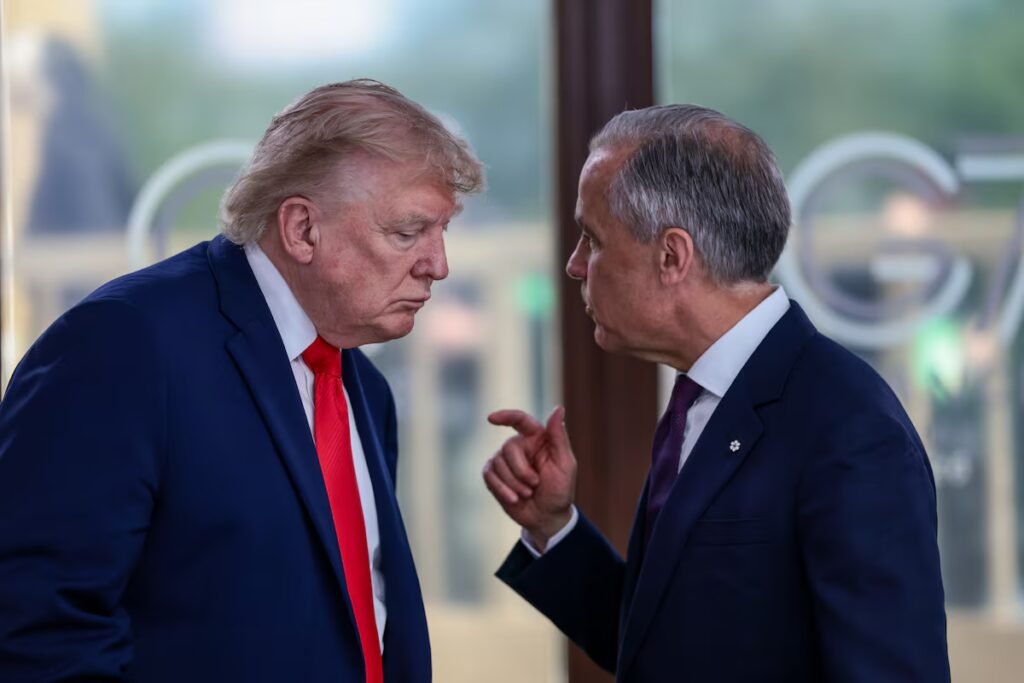

Donald Trump speaks with Mark Carney at a G7 working lunch in Evian-les-Bains, France, on June 16. The leaders spoke by phone late Monday, ahead of a Wednesday tariff deadline.Evelyn Hockstein/The Associated Press
Tense talks between Canada and the United States reached the leader level late Monday with Prime Minister Mark Carney and U.S. President Donald Trump holding a call as Ottawa tries to avert punishing new tariffs.
The Prime Minister’s director of communications, Jane Deeks, said in a brief statement to The Globe and Mail that the two leaders spoke on the phone. They spoke after a flurry of meetings between officials and top negotiators over the weekend and into Monday.
Canada-U.S. Trade Minister Dominic LeBlanc remained in Washington with the Prime Minister’s top negotiator Janice Charette.
Canada-U.S. Trade Minister Dominic LeBlanc says talks with his American counterparts will continue after a meeting with U.S. Trade Representative Jamieson Greer and U.S. Commerce Secretary Howard Lutnick as the deadline closes in on deferring hefty tariffs.
The Canadian Press
Ms. Deeks said she couldn’t comment on whether Mr. Trump and Mr. Carney would also speak Tuesday.
Talks are now down to the wire as Canadian negotiators have just hours left before new 50-per-cent tariffs come into effect at 12:01 a.m. on Wednesday, under Section 338 of the Smoot-Hawley Tariff Act.
The U.S. tariffs would be imposed on US$20-billion worth of Canadian electronics, dairy, alcohol, wood and other products. The tariffs target B.C., Ontario and Quebec the most − provinces that have maintained booze bans on U.S. products in retaliation for U.S. tariffs imposed last year.
Canadian negotiators are trying to strike a deal that averts those Section 338 tariffs and also addresses the longer standing Section 232 tariffs on autos, metals and forestry, imposed last year under the Trade Expansion Act.
With auto tariffs a key sticking point, Canada’s industry hangs in the balance
On Monday, the Prime Minister told reporters he had plans ready for any outcome of the talks.
Sources have told The Globe that Canadian negotiators are looking at accepting a lower level of tariffs on the sectors subject to the Section 232 levies in exchange for concessions from Canada, including provinces lifting their U.S. alcohol bans and Ottawa dropping its counter tariffs on autos.
The level of tariffs that would apply to autos and lumber remain sticking points, according to sources with knowledge of the talks.
Three sources with knowledge of the talks said the U.S. is holding firm to its position on autos, leaving one of the toughest issues to crack for the final dash to a deal.
The Globe is not identifying the sources because they were not authorized to disclose details of the confidential negotiations.
Those briefed on the talks were divided about the possibility of the two countries reaching a deal by tonight. Some said they were cautiously optimistic while others believed they were still far apart.
While some on the Canadian side believed that the most likely outcome is a delay to the Section 338 tariffs and more talks, sources briefed on the U.S. position were skeptical Canada would get anything more than a short extension.
Tony Keller: The end of USMCA would have a surprisingly small impact on the Canadian economy
One of the sources noted that the purpose of the latest tariffs was to press Canada into a deal, so further extensions wouldn’t make sense.
The U.S. Chamber of Commerce released a statement Tuesday morning urging the two countries to reach a deal.
“The introduction of higher tariffs would damage both economies, drive up costs for U.S. families, further disrupt critical supply chains, and risk the 13 million American jobs that depend on trade under the U.S.-Mexico-Canada Trade Agreement,” said Neil Herrington, senior vice-president for the Americas at the chamber.
Mr. Herrington advocated for a deal that “significantly reduces” the Section 232 tariffs on all of the affected sectors. On Canada’s side, he advocated for the country to end its booze bans, enhance access for dairy producers and address Canada’s retaliatory tariffs.
With a report from Mark Rendell


More Stories
Quebec has lost its economic ambition, high-profile business leaders say
Financial-crime regulations governing lawyers require ‘considerable improvements,’ watchdog says
Oil industry faces major spending hikes to fill planned pipeline expansions