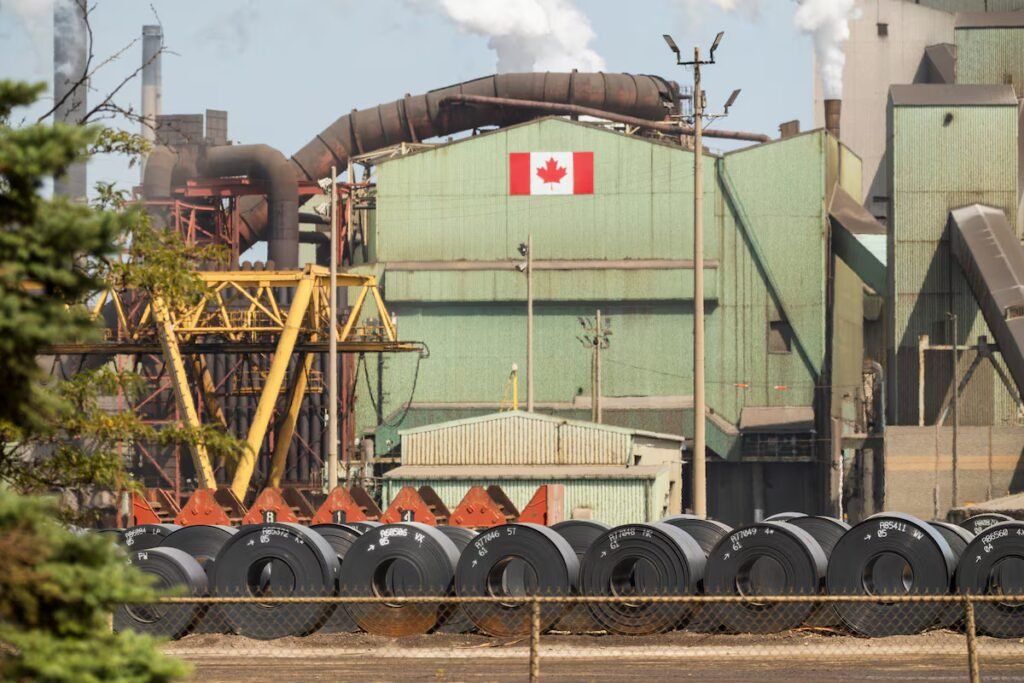

Rolled coils of steel sit in the yard at the ArcelorMittal Dofasco steel plant in Hamilton, Ont., on Thursday. As part of a trade deal, Canada is seeking to reduce U.S. tariffs on steel and aluminum.Nick Iwanyshyn/The Canadian Press
Dominic LeBlanc, the Minister responsible for Canada-U.S. trade, and chief negotiator Janice Charette will meet with U.S. Trade Representative Jamieson Greer in Washington on Friday, hours before the latest deadline to lock down the details of a trade deal.
The trio will hunker down at Mr. Greer’s office near the White House on Friday morning. The sit-down follows a more than three-hour meeting on Thursday afternoon, followed by more meetings between Ms. Charette and Mr. Greer’s subordinates.
At stake is a trade agreement Canada is banking on to lower U.S. President Donald Trump’s current tariffs and avoid the imposition of new ones.
Mr. Trump on Tuesday postponed his latest threatened tariffs by three days, saying the two countries had reached a trade deal but still needed to finalize its wording. He will have to take action again. Otherwise, the 50-per-cent levies on US$20-billion worth of Canadian exports will start at 12.01 a.m. Saturday.
Mr. LeBlanc leaves after meeting with U.S. Trade Representative Jamieson Greer at the Office of the United States Trade Representative in Washington on Thursday.MANDEL NGAN/AFP/Getty Images
In the negotiations, Canada is seeking to reduce Mr. Trump’s current tariffs of 50 per cent on steel and aluminum, 25 per cent on autos, and between 10 to 25 per cent on forestry products, imposed last year under Section 232 of the Trade Expansion Act of 1962. Canada is also hoping to avoid Mr. Trump’s new threatened tariffs, which would take effect under Section 338 of the Smoot-Hawley Tariff Act of 1930.
In exchange, the U.S. wants Canada to concede on a long list of trade demands, The Globe and Mail has reported: ending retaliatory tariffs on U.S. autos, changing how licences are allocated under the dairy supply-management system, and having provincial premiers end retaliatory bans on U.S. alcohol and Buy Canadian procurement policies.
Proposed Canada-U.S. trade deal would lock in 15% auto tariffs, sources say
The U.S. has also demanded that Canada give Washington right of first refusal on purchasing Canadian critical minerals, complete the purchase of F-35 fighter jets, buy U.S. military equipment as part of joining the planned Golden Dome missile defence system and increase oil exports.
The prospective deal, in which Canada is being asked to make numerous concessions and accept Mr. Trump’s tariffs in exchange for not having the tariffs be even higher, is likely to be a difficult sell for Prime Minister Mark Carney.
Mr. Carney, who rode to power promising an “elbows up” approach to Mr. Trump’s tariffs and threats of annexation, has already drawn criticism from Manitoba Premier Wab Kinew for not holding out for a better deal. He warned that making concessions now puts Canada in a weaker position ahead of a planned overhaul of the U.S.-Mexico-Canada Agreement later this year or early next.
Manitoba’s Premier says he is reluctantly open to returning U.S. booze to provincial shelves as part of a trade deal, but hopes Canadians won’t buy it. Wab Kinew says he’s still waiting for key details, including what the final tariff rates will be, before making any commitments.
The Canadian Press
“I just wonder if accepting the idea that Trump tariffs are here forever is the move where we wanted to give up some of that leverage,” Mr. Kinew told reporters on Thursday. “If we kept pushing, I think that we’d probably get more.”
The co-operation of Mr. Kinew and other provincial premiers will be key for getting the deal through, as they will have to stop their bans on U.S. alcohol. Ontario Premier Doug Ford and B.C. Premier David Eby who, along with Mr. Kinew, have been the most outspoken critics of Mr. Trump, have not said what they will do. Quebec Premier Christine Fréchette has said she is still deciding.


More Stories
Canadian heavy oil discounts deepen on supply glut
Ottawa expands military space ambitions with launch, satellite funding
National Bank CEO calls for overhaul of Canada’s tax code