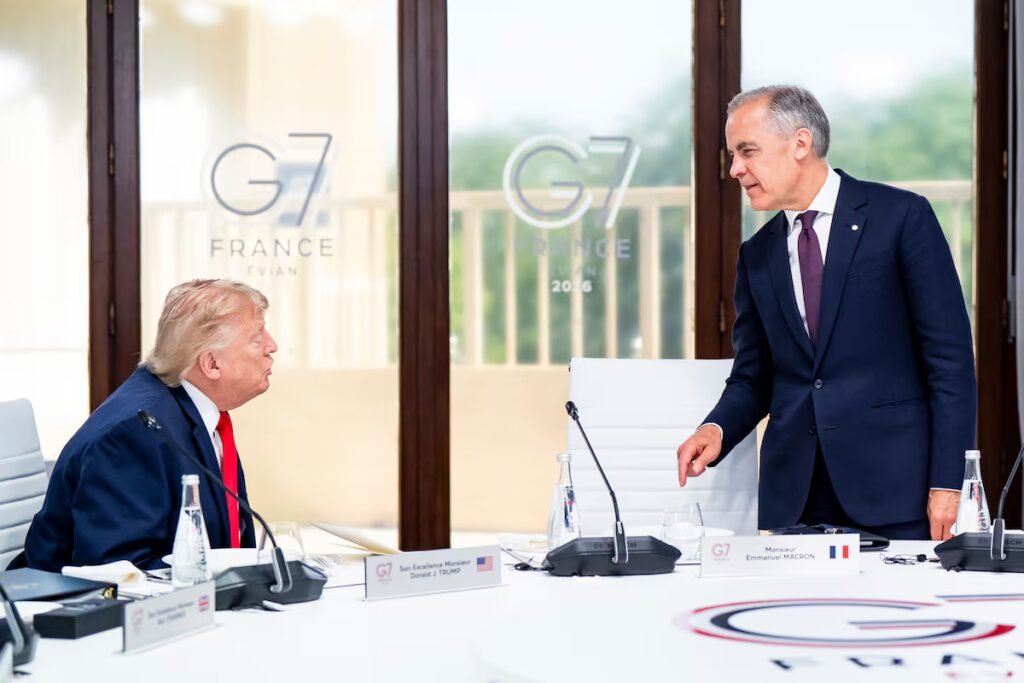

Canada’s Prime Minister Mark Carney and U.S. President Donald Trump speak at the G7 summit in Evian-les-Bains, France, on June 16. Prime Minister Mark Carney’s weakness has been allowing the U.S. to bank one concession then move onto another demand, Jerome Gessaroli writes.Christopher Katsarov/The Canadian Press
Jerome Gessaroli is a senior fellow at the Macdonald-Laurier Institute and leads the Sound Economic Policy Project.
The Carney government should not be surprised that the U.S. administration is again using tariff threats to secure Canadian concessions.
Ottawa helped make itself predictable. Over the past year, Washington has learned that Canada is divided and that applying pressure can produce results.
Reacting when the White House announced additional tariffs in July, Prime Minister Mark Carney and the premiers were quick to offer words of national unity, and commitments to protect Canadian workers and families. But those words showed agreement on an objective, not on the strategy of getting there. Without a unified strategy, the objectives become harder to reach.
Mr. Carney’s priority should have been agreeing on a common plan with provincial leaders, which would include establishing credible countermeasures. Instead, premiers Doug Ford of Ontario, Danielle Smith of Alberta and Scott Moe of Saskatchewan went public with their own conflicting positions. Mr. Ford stated that Canada is an “energy powerhouse” and should “hit them back as hard as we can” if negotiations fail, while Ms. Smith and Mr. Moe categorically ruled out using energy or potash as potential bargaining chips.
The country could not even find common ground on keeping U.S. liquor products off retail shelves, a relatively high-impact and low-cost measure for the provinces. It’s no surprise that Canada is now buckling altogether, with Mr. Carney asking premiers to allow American liquor back.
Those public disagreements had weakened Canada’s bargaining position and conveyed to Washington which economic tools Canada was unlikely to use.
All’s fair in love and trade war, and Canada must play dirty, too
More damaging than provincial disagreements were Mr. Carney’s responses to coercive threats. In June, 2025, U.S. President Donald Trump suspended trade talks over Canada’s 3 per cent digital services tax (DST) on large technology companies. Almost immediately, Canada abandoned the tax along with amounts owing without making any durable progress towards a broader agreement.
The U.S. administration’s threat to block the opening of the Gordie Howe Bridge is another example. Canada financed the entire $6.4-billion project with an agreement to keep all tolls until its investment was recovered. The U.S. administration withdrew its threat after Canada agreed to share net toll revenue for the first 15 years after deducting operating expenses, but not interest or debt costs.
While Canada does not need to dig its heels in over every policy (the DST may not have been worth defending), the concessions made in both cases should have been exchanged for a durable U.S. commitment. Mr. Carney’s weakness has been allowing the U.S. to bank one concession then move onto another demand.
As this country continues trying to hash out a permanent deal, Canada has options it can use, but they are limited and costly. Trade action has to be limited in scope and scale to avoid an all-out trade war. Currently, Washington may doubt Ottawa can implement and sustain such countermeasures. In other words, the threats lack credibility.
While Mr. Carney has spent substantial effort on trade diversification, that will not help Canada in the short term. It is essential to develop new markets and lessen dependence on the U.S., but those are medium- to long-term activities.
Ottawa’s immediate task is to improve co-ordination with the provinces before the premiers publicly voice conflicting positions. The point is not to stop Ms. Smith, Mr. Ford and the other premiers from speaking up for their own constituencies. They will do so. Rather, it is to find agreement on which trade measures are truly available before publicly ruling them out. Once agreed upon, the measures should remain private and only be announced once their use becomes imminent.
Ottawa should act directly on measures within its jurisdiction that will have little provincial impact. But measures requiring provincial co-operation will need an agreement with the affected provinces before they are included in Canada’s trade toolkit.
For example, Ottawa could co-ordinate with the provinces to implement common procurement restrictions on U.S. suppliers bidding on government contracts. The scope, triggers and duration could all be agreed upon. This would improve credibility and negotiating leverage compared with the piecemeal procurement policies several provinces have adopted.
When such measures impose costs concentrated on a specific sector or province, Ottawa can financially support that affected sector or province to sustain the countermeasure.
While Canada cannot change its power imbalance with Washington, it can use its leverage more effectively. If Ottawa agrees to further isolated concessions and the premiers publicly voice contradictory views over strategy, Washington will see a green light for even more threats.


More Stories
Russia to supply more than 300,000 tons of diesel to U.S. and global market, Trump says
Pitching in: Fundraising for Princess Margaret Hospital one goal at a time
Interest rates are rising. It’s not clear why. But soon something will break