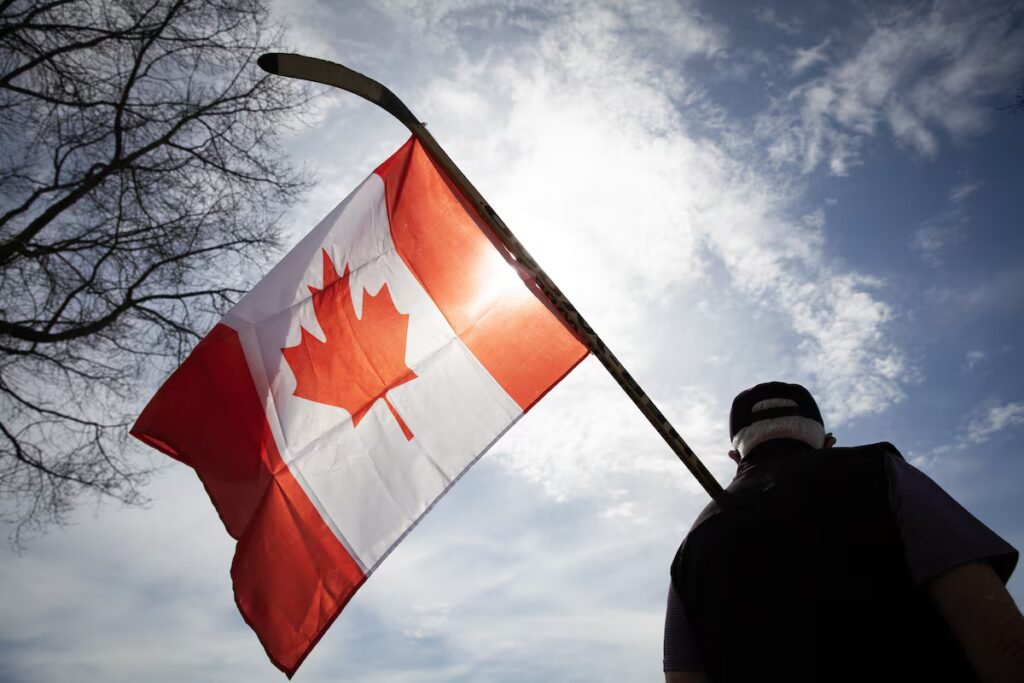

A man holds the Canada flag on a hockey stick at the Canada/U.S. solidarity rally at Peace Arch Park in Surrey, B.C., in April, 2025.Nav Rahi/The Globe and Mail
John Rapley is a contributing columnist for The Globe and Mail. He is an author and academic whose books include Why Empires Fall and Twilight of the Money Gods.
U.S. President Donald Trump wasn’t wrong when he said that Canadians got to enjoy all the benefits of U.S. statehood without being one.
Free trade enabled Canada to shelve concerns with innovation or industrial modernization, ship primary materials to the American industrial economy, and live an easy life. Furthermore, knowing that the U.S. would never allow a hostile country to invade Canada, we were also able to slash our defence budget to the bone, offloading our security to the Americans.
For decades, we got to have our cake and eat it. We can’t blame Mr. Trump for now saying, after the breakdown of trade talks, that we either buy the cake or lose it.
In depth: From flower farmers to cheesemakers, meet the business owners and leaders affected by the trade war
So far, Canadians have rallied behind the flag. The day after talks broke down, Prime Minister Mark Carney alluded to being “at war” and talked of being “masters of our own destiny.” More emotional than usual, Mr. Carney said, “We can chart a new course by building Canada strong at home and diversifying our trading relationships abroad.”
It’s an achievable goal, to be sure. In the current skirmish, Canada enjoys an edge. That’s because while the U.S. possesses the overwhelming economic might to crush Canada, much as is the case in its botched war on Iran, it lacks a mandate for war, has no strategy to win it, and little political capacity to absorb its costs.
But that won’t always be the case. Suppose Mr. Trump, or a future MAGA president, were to obtain a mandate to fully implement the “Donroe doctrine” that has become a leitmotif of this administration, and then crafted a strategy that was as detailed as the national-security doctrine it produced last year.
Canada can’t assume that a Democratic tide in the November elections, or even a Republican defeat in the 2028 presidential election, will end this menace. Even California Governor Gavin Newsom, Democratic-flagbearer aspirant, says he “can’t guarantee” tariffs would go away if his party is in power.
Opinion: Americans don’t understand Trump’s trade war against Canada. Here’s how to explain it to them
Canadians now face an existential choice that they’ve never confronted in their lifetimes: whether to continue living in a sovereign, independent country or become the 51st American state. The country will have to be prepared to stand its ground, if it wishes to remain independent.
It can never match its huge southern neighbour, but it doesn’t need to. It needs only to raise the costs of confrontation to render them so unappealing that no president would risk it.
In effect, in fortifying its economy, Canada would need to develop a total-defence approach akin to what Finland historically used to preserve its independence from Russia: a complete mobilization of society around preparedness.
Finland could never defeat Russia, but it had the capacity to make life miserable for Russian invaders. In the 1939-40 Winter War, Finland inflicted on Russia five times the number of casualties it had suffered. By preparing for war, Finland ensured it could live in peace.
Canada has already begun to rebuild its military and may want to alter its procurement to reduce U.S. dependence. But to survive a more likely economic war, it would need to build upon what the government is now doing – seeking new markets to reduce Canadian vulnerability and developing new and specialized products that other countries might not easily replace.
This is how China managed to force the U.S. to back down in its brief trade war – it controls so much of the critical-minerals supply chain, right up to advanced processing, that the U.S. could not live without it.
Eric Reguly: Defying Trump came with no loud cheers from world leaders. They will reward Carney in other ways
To forge into new industries, Canada’s universities will probably need to assume a greater leadership role than they currently do. This country’s recent poaching of 48 U.S. academics, under a $1.7-billion federal program, is a good first step. But despite spending only about a third more than Canada on tertiary education, Britain has four times as many universities in the global top hundred, suggesting some Canadian faculties are punching below their weight.
Equally, the country’s banks and pension funds will need to be prodded into sinking less of their money into the U.S. and more into Canada, while shifting away from primary industries into those that capture niches in emergent technologies.
Governments will need to maintain the tricky balance between investing to help develop new industries and maintaining the country’s relatively good fiscal standing.
In the current battle, Canadian government bonds have outperformed their American counterparts, giving the government more fiscal leeway to cushion businesses and individuals caught in the tariff crossfire.
U.S. businesses fear prolonged trade war with Canada could permanently strain cross-border ties
That ‘strategic depth’ must always be maintained. For their part, provincial governments must finally tear down the interprovincial barriers that prevent the country developing a truly national market.
In the short to medium term, all this would entail costs. As investment came home and pivoted to new industries, returns would diminish (though if the investments were done properly, they would probably rise faster down the road). That could affect asset owners today, including existing pension beneficiaries.
Measures to spur productivity growth or reduce interprovincial barriers might in turn affect job conditions and living standards for some groups during a transitional period.
Canadians will have to decide whether the price of nationhood is worth paying.
Ernest Renan described nationhood as a daily plebiscite. In their spending, investment and voting decisions, Canadians will henceforth be called upon to express their decision. In time, the country may opt to return to the easier life it had and slide quietly into the American embrace, or it may decide to remain independent.
But if the latter, while the war won’t be permanent, preparedness for it must be.


More Stories
Investor doubts over data centre push hits AI stocks, bonds
Military conflicts and Trump’s failed Russia-Ukraine truce roil oil markets
U.S. business inflation heating up, could lead to even higher prices for American shoppers