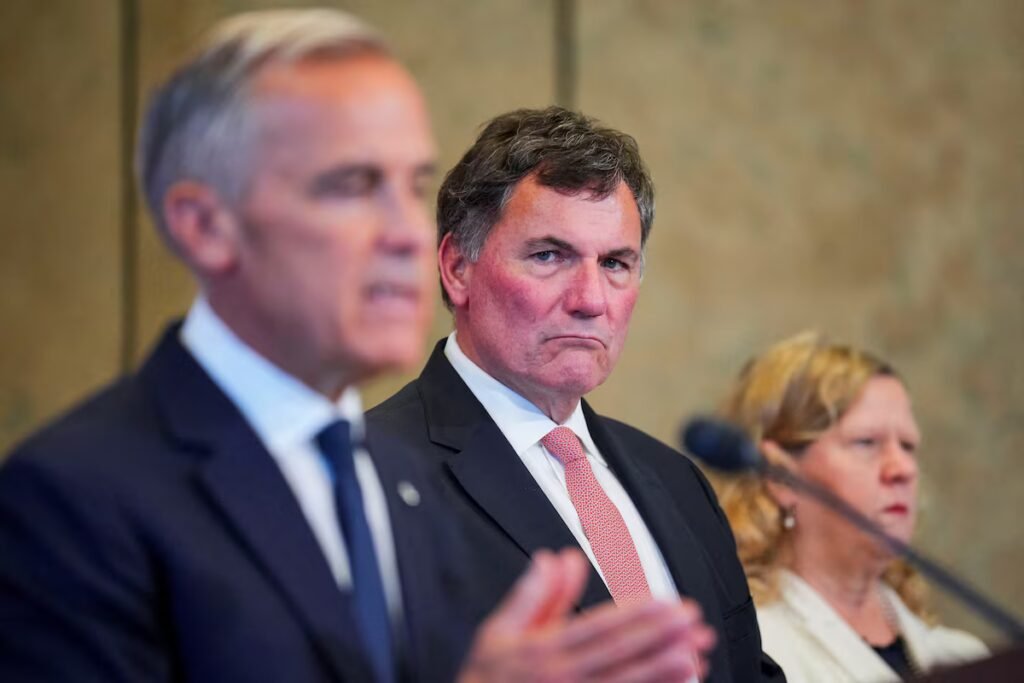

Dominic LeBlanc, looks on while Prime Minister Mark Carney speaks with the news media after he suspended trade negotiations with the United States, in Ottawa, Aug. 22. Carney promised ‘dollar-for-dollar’ retaliation in the form of tariffs against American exports to Canada that are set to take effect on Sept. 8.Chris Tanouye/Reuters
Canadian business leaders have been left in a precarious state of limbo after an 11th-hour collapse in trade talks with the United States also eliminated hopes for an end to the uncertainty that has long paralyzed their investment decisions.
President Donald Trump’s threatened 50-per-cent tariffs on US$20-billion worth of goods sold to American customers each year took effect at 12:01 a.m. on Saturday. Both countries blamed each other for the negotiations falling apart just when a deal appeared to be within reach.
At a Saturday morning press conference, Prime Minister Mark Carney said the Canada-U.S. trade relationship faces an existential threat as the cumulative effect of Washington’s demands “revealed the limits of their commitment to a true economic partnership.”
Asked about the tone of his remarks, which suggested that Canada is at war, Mr. Carney said: “You are at war when you get attacked. We got attacked.”
He promised “dollar-for-dollar” retaliation in the form of tariffs against American exports to Canada that are set to take effect on Sept. 8.
Ottawa fires back after rejecting U.S. trade deal
Mr. Trump’s latest round of tariffs primarily target Canada’s manufacturing sector. Dennis Darby, chief executive officer of industry group Canadian Manufacturers and Exporters and a member of Mr. Carney’s advisory committee on Canada-U.S. economic relations, said the Prime Minister’s language suggested “he is setting up for the long haul.”
“Our preference is for them to quickly get back to the table, but I don’t think that is going to happen any time soon,” Mr. Darby said in an interview on Saturday. “The bigger problem for us is that in the long run, if this back and forth persists, it erodes the confidence companies have to make investment decisions.”
“Not only has it been uncertain, but now it might become even more volatile,” he said.
Canada’s forestry sector, meanwhile, is “very much collateral damage” in the trade dispute, Forest Products Association of Canada CEO Derek Nighbor said in an interview on Saturday.
Softwood lumber already faces a 10-per-cent levy under U.S. Section 232 tariffs in addition to cumulative 35-per-cent anti-dumping and countervailing duties. Now, billions of dollars’ worth of wood and paper products will face 50-per-cent tariffs.
“We’re very disappointed. This is going to be very difficult for our sector,” Mr. Nighbor said.
He plans to work with the government on support to counteract the impact of the latest trade-war escalation, something Mr. Carney said Ottawa will provide.
Mr. Darby said financial support will “help keep people on the payroll, but it is not a long-term solution for sure.”
The deal that was ultimately abandoned would have been particularly punishing for the steel sector, with The Globe and Mail previously reporting that Canada would have been obliged to accept both a four-million-tonne quota on exports to the U.S. and a tariff of 25 per cent on steel within that quota. Above the quota, the levy would be 50 per cent. In addition, Canada would have had to remove all of its countertariffs on U.S. steel.
That would not have been a sustainable option for Canada, according to the head of Canada’s main steelworkers’ union.
“This isn’t a war as in guns and boots on the ground, but this is an economic war,” Marty Warren, United Steelworkers national director for Canada, said in an interview. “It’s up to our generation to stand up for future generations and not lose control of our sovereignty and our Canadian economy, and that’s what was at risk.”
The new tariffs will even apply to certain goods covered under North America’s continental trade deal, the United States-Mexico-Canada Agreement.
“This is a major break from the current tariff environment, where 90%-plus of Canadian exports not targeted by specific levies have continued to move tariff-free under cover of the existing trade agreement,” BMO Capital Markets senior economist Robert Kavcic said in a research report published on Saturday morning. “This raises more questions on the usefulness of the existing USMCA.”
Canadian business investment has recently started climbing to its highest level in a decade, though Mr. Kavcic said the last-minute breakdown in trade talks could reverse that momentum.
“Although businesses had been showing signs of looking past tariff headlines, this would be the toughest action since the spring of 2025,” he said.
“On one hand, businesses could again recognize the need to move past the tariff news; on the other, questions about the effectiveness of the USMCA and potential for any lasting trade deal could hit business investment over the longer term.”
The impact of the latest round of tariffs on small businesses “will be immediate and significant,” Canadian Federation of Independent Business president Dan Kelly said in a statement.
Opinion: Canada didn’t chicken out. We did the right thing
According to a survey of 1,833 CFIB members conducted in late July, roughly 40 per cent of respondents said they would be affected and of them, one third said they expect to lose at least half of their revenue as a result of the new levies.
Even businesses not affected directly by Mr. Trump’s most recent tariff salvo have cause for concern.
“The unpredictability of U.S. administration tariff policy means it is not possible for businesses to predict which sectors might be next,” RBC Economics said in a report published on Saturday.
“And that unpredictability is a weight on business confidence across all trade exposed industries, not just those directly targeted with tariffs.”
Gord Nixon, a former CEO of Royal Bank of Canada who is currently a member of the board of directors for George Weston Ltd. and investment giant BlackRock Inc., said in an interview that current circumstances reinforce the damage that Mr. Trump has inflicted on Canada-U.S. relations since launching his global trade war last spring.
“The worst-case scenario is more and more escalation and that’s what hopefully they’re trying to avoid, but whether it’s avoidable or not is a $64,000 question to which I don’t think anyone has the answer because you’re dealing with a very unpredictable side,” Mr. Nixon said.
“The Prime Minister and Canada are very predictable. We’ve got a brilliant negotiating team and a very strong and rational and logical Prime Minister, but you can’t negotiate with yourself.”


More Stories
AI-centered U.S. stock bull market nears four-year mark
Delta Air cuts profit forecast as $6-billion fuel-cost surge outweighs fare gains
Wall Street’s week ahead: Bank earnings, CPI headline busy markets week as S&P 500 hovers near records