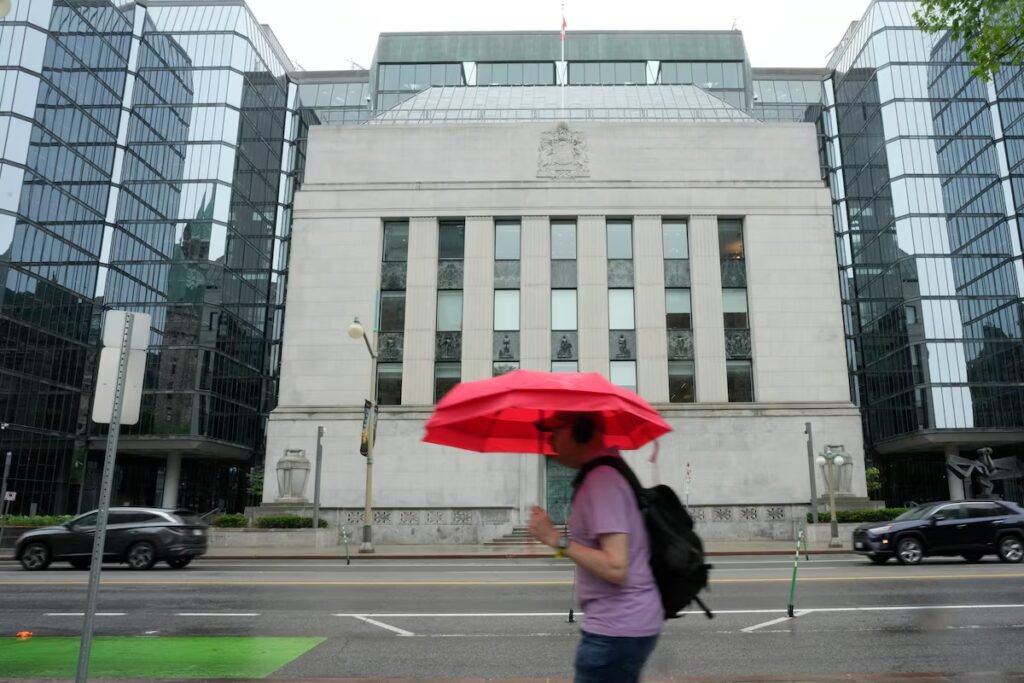

Good morning. The Bank of Canada is widely expected to hold rates steady at 2.25 per cent today, as it has all year. The more relevant question is whether the next move is up or down – and on what timeline. Keep scrolling for the details to consider for your calendar.
Up first
In the news
Trade: Canada is willing to return to the negotiating table once the U.S. changes its tone and can “stop doing memes, stop throwing shade, stop trying to be tough and start being serious,” Prime Minister Mark Carney said.
Labour: Unifor began contract talks with Stellantis, vowing to fight for the Brampton assembly plant’s future, while securing production volumes at factories in Windsor and Toronto.
Streaming: JioHotstar, one of India’s largest streaming services, launches in Canada today with offerings ranging from reality TV shows to Bollywood movies.
A pedestrian walks past the Bank of Canada in Ottawa, June 10.The Canadian Press/The Canadian Press
In focus
Forecasting the Bank of Canada
Hi, I’m Matt Lundy, economics editor at The Globe. The Bank of Canada will make its next interest-rate decision on Wednesday morning. Don’t expect any fireworks. Regardless, there will be plenty to unpack.
Rate path
Investors have certainly cast their vote: Lending rates will be much higher by next summer. As of Tuesday, swaps markets were pricing in one quarter-point rate hike by January and three by July, according to Bloomberg data. Those would take the central bank’s benchmark interest rate to 3 per cent.
But there’s a difference between expectations and reality. Investors have been quick to predict a rate-hike cycle that, as of yet, hasn’t materialized. In the spring, for instance, swaps markets were pricing in a rate hike for today, on account of inflationary pressures stemming from the Middle East war.
Economists on Bay Street have overwhelmingly projected rates to hold steady this year – so far they’ve been proven correct – as the Bank of Canada weighs the stagflationary risks posed by protectionism.
Still, market watchers will be closely parsing Governor Tiff Macklem’s comments for how the central bank is thinking about this new phase of the Canada-U.S. trade war.
Trade comments
Canada is around 18 months into a trade war with the United States that, as early as next week, could ratchet up further, with Ottawa set to impose countertariffs on some American goods. The U.S. has threatened to retaliate against Canada’s retaliation, adding even more uncertainty to the near-term outlook.
The trade war is a tricky situation for the BoC, because these barriers constrain economic growth (a reason to cut rates) while also raising prices (a reason to hike rates). And as Macklem has stressed before, monetary policy can only help the country so much.
“The Bank of Canada hasn’t recently outlined a playbook for dealing with both upside inflation risks and downside growth risks,” Royce Mendes, head of macro strategy at Desjardins Securities, said in a recent client note. “At a time when the nation’s economy is under assault, it could be argued that monetary policy needs to row in the same direction as fiscal policy,” he added, meaning lower lending rates to support the economy.
“But taking a step back, the Bank of Canada’s inflation mandate dictates that monetary policy respond to price pressures ahead of growth concerns when the two are in conflict.”
Inflation
If Canada imposes countertariffs on Sept. 8, as currently planned, that would likely give a modest lift to the overall inflation rate. This was observed last year, when Ottawa retaliated against the early rounds of American tariffs on Canadian products.
This year, the added risk is that consumers are facing major pain at gas stations, given the trickle of oil shipments through the Strait of Hormuz. West Texas Intermediate pushed above US$90 a barrel yesterday on renewed fighting between the U.S. and Iran.
The conflict is having a big effect on consumer prices. Canada’s headline inflation rate hit 3 per cent in July, the top end of the BoC’s target range. (While the central bank’s inflation target is 2 per cent, it has some wiggle room on either side, so that it doesn’t overreact to temporary factors affecting prices.) Core measures of inflation, which strip out volatile price movements, are more in line with the bank’s target, suggesting inflation isn’t overly worrisome.
That could prove fleeting, on account of a U.S.-Iran war and a U.S.-Canada trade war that aren’t relenting. In all likelihood, the BoC will need to stand by and see how those situations develop. But again, Macklem’s comments will be under the microscope for any clues on the rate path.
Charted
The right balance
No Canadian-listed ETF tracks the MSCI World Equal Weighted Index, but there are some other options, which have their own pros and cons. Equal-weight indexes tend to outperform, but can also lag over extended periods. Investment reporter Andrew Galbraith answers a reader question: How can I buy an equal-weighted global ETF?
Quoted
I won’t pretend I’m a deep tech expert, but I’m pretty good at picking out people who have a chance of being great entrepreneurs, and she just struck me that way.
— Daniel Debow, angel investor and ex-Shopify Inc. executive
Olivia Leng, 21, is a piano teacher, a powerlifter and an entrepreneur with an ambitious goal: invent a high-performance superconducting material that would make quantum computers more commercially viable. Her tech startup, Meissner, just scored millions in funding from prominent financiers, Sean Silcoff reports.
Up next
More files we’re following
Feeling: Finance Minister François-Philippe Champagne says Russia’s presence at a G20 meeting hosted by the U.S. has made many countries uncomfortable.
Taste: Patrons of Schwartz’s Deli, the Montreal smoked-meat institution, love the locally brewed black cherry soda that replaced an American offering on the restaurant’s menu.
After the bell: We’re watching for earnings reports expected from Broadcom Inc. and Hewlett Packard Enterprise Co.
Morning update
Global markets fell as fresh U.S. airstrikes on Iran pushed oil prices to five-week highs, stoking inflation concerns and extending a global bond sell-off.
Wall Street futures in the red after major North American markets closed down yesterday. TSX futures followed sentiment lower.
Overseas, the pan-European STOXX 600 was down 0.57 per cent in morning trading. Britain’s FTSE 100 fell 0.56 per cent, Germany’s DAX dropped 0.77 per cent and France’s CAC 40 gave back 0.62 per cent.
In Asia, Japan’s Nikkei closed 2.85 per cent lower, while Hong Kong’s Hang Seng slipped 0.07 per cent.
The Canadian dollar traded at 71.73 U.S. cents.


More Stories
The world may be going to hell in a handcart, but Canada is not. Not today
Green investment guidebook authors hold off on adding carbon capture for oil, gas after pushback
Six charts that show how B.C.’s fiscal outlook has gotten worse