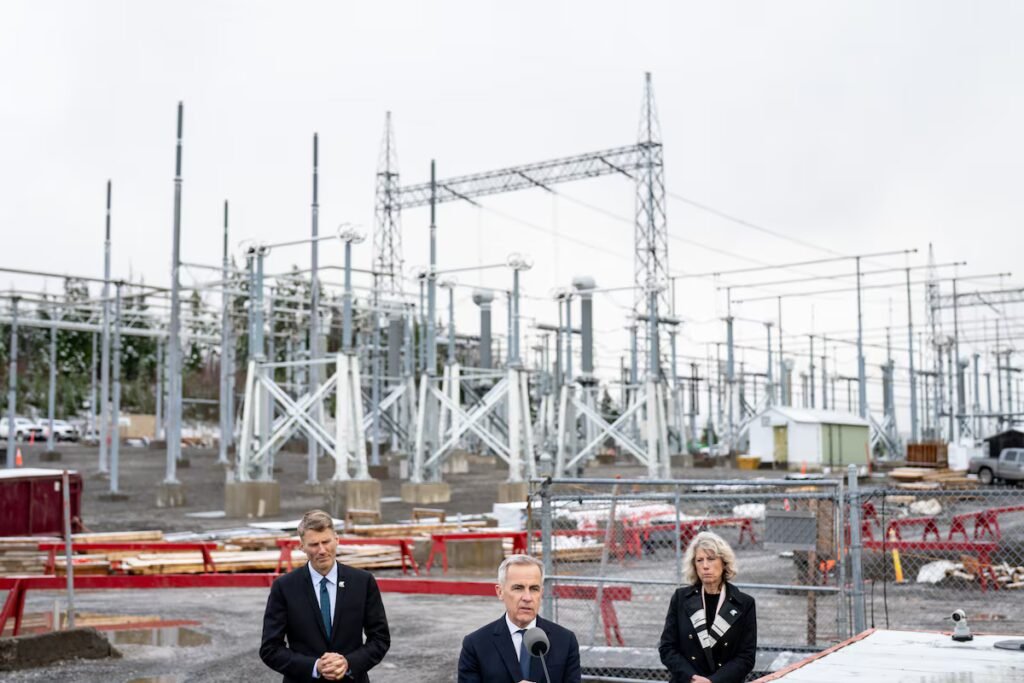

Good morning. The Major Projects Office has a small army of staff plucked from the public and private sectors who are helping advance the Prime Minister’s dream for a national construction boom. As we reach the office’s one-year mark, we take a dive inside the opaque agency advancing Mark Carney’s agenda, the challenges so far and the pressures ahead.
Up first
In the news
Trade: Premier Doug Ford is open to lifting Ontario’s ban on U.S. alcohol even if tariffs on autos, metals and forest products are only reduced and not eliminated.
Defence: Canada is moving quickly to secure a long-range strike system that’s proved effective in the war in Ukraine.
Markets: This is why Canada is not immune to the effects of Japan’s surging bond yields.
Prime Minister Mark Carney, Minister of Housing and Infrastructure Gregor Robertson, left, and CEO of the Major Projects Office Dawn Farrell during an announcement at Skeena Substation in Terrace, B.C., on Nov. 13, 2025.ETHAN CAIRNS/The Canadian Press
In focus
Pressure down the pipeline
Jeff Jones here from Calgary, home of Prime Minister Mark Carney’s Major Projects Office. It’s been almost a year since the office opened and, in that time, it has generated scads of headlines as his government referred for review multibillion-dollar proposals it believes could be in the national interest.
Its mission: To reverse industry’s long-standing concerns that webs of regulations and intractable court battles have stalled big developments and prompted private capital to seek returns elsewhere. The agency is emblematic of Carney’s aim to spark a building renaissance.
But how it all works is not well understood. The MPO is drawing criticism from some in the business community about a lack of transparency for a taxpayer-funded body with so much responsibility.
To be sure, there’s a lot riding on the MPO’s work as Canada strives to bolster its economy against the salvos of U.S. President Donald Trump’s trade war.
That’s why senior Ottawa reporter Stephanie Levitz and I spent two months digging into the MPO’s workings to take a look at how it is performing as its 150 staff members pore over $192-billion worth of projects. Proposals include a panoply of mines, Arctic roads, electricity-transmission networks and ports.
Oh, you may have heard that there’s also a proposal for an oil pipeline.
With Mark Carney looking on, Premier Danielle Smith shakes hands with Dawn Farrell during an announcement on Alberta’s proposed West Coast oil pipeline in Calgary, on July 2.Sarah B Groot/The Globe and Mail
For this weekend’s long read, we spoke to numerous executives and government insiders, studied reams of documents and reviewed hours of parliamentary testimony to see how this operation works as it heads into a crucial period when it will start issuing its recommendations on key projects.
The office, led by energy-industry veteran Dawn Farrell and staffed by professionals from the private sector and federal bureaucracy, looks for ways to fast-track development by helping proponents navigate regulatory processes, tap funding sources and engage with Indigenous communities. The overall goal is to reach approval decisions in under two years with minimal legal risk.
Some of the perceived opaqueness may stem from Farrell herself, who is adamant about letting the government do the talking. She has been known to say that public speaking would take valuable time away from doing the actual work of moving major projects forward.
Front and centre in that quest is that one-million-barrel-a-day pipeline to the West Coast proposed by the Alberta government, and led by federally owned Trans Mountain Corp. This is the marquee proposal in the memorandum of understanding signed last year by Carney and Alberta Premier Danielle Smith, seen as a potential bulwark against separatist sentiment in the province.
The pipeline is what Adam Waterous, executive chair of oil producer Strathcona Resources Ltd., told me he believes is the MPO’s “main event.”
The conduit to the Pacific will be key to achieving a goal of doubling oil production over the next decade, a prospect that will drive a transformational increase in Canadian GDP, Waterous said. (Those more focused on emissions and costs of climate-related impacts, of course, take a much dimmer view, especially with British Columbia struggling through another season of destructive wildfires.)
“The only thing that’s been comparable from an economic perspective in terms of impact on the country over time would be the original free-trade agreement that Brian Mulroney drove in the 1980s,” Waterous said.
We hope you’ll take some time to read our feature, Inside the agency advancing Carney’s major projects agenda, in which we try to piece together what the MPO could mean for the Canadian economy and government accountability.
Charted
Dancing and dealing with the Donald
Canada’s current rush to reach a deal is a mistake, writes Andrei Sulzenko, who was a principal negotiator of the Canada-U.S. free-trade agreement. Instead, Ottawa should treat Aug. 19 as a TACO moment that will be rolled over repeatedly.
Quoted
It’s our backyard, it’s our device. We are a Canadian company, and simply, the Canadian system doesn’t make it easy for any patient to get it.
— Gualtiero Guadagni, chief executive officer of Bionic Power
To help him climb Everest after a painful disability, a Briton got a Canadian bionic exoskeletal upgrade. However, the cost of the device varies greatly from patient to patient. And depending on where you live, so does the health-insurance reimbursement.
Up next
More files we’re following
By the numbers: We’re keeping an eye out for data coming today on Canadian manufacturing shipments and wholesale sales for June.
Back to school: Tips and traps for students borrowing money to pay for an education from Tim Cestnick.
Back to building: Ontario unveils a framework for new data centres to ensure benefits for local economies and proposes a higher electricity rate.
Morning update
Global markets were mixed as benign inflation data dented expectations of an imminent U.S. rate hike, although faltering talks to end the war in the Middle East are likely to keep risk sentiment in check.
Wall Street futures were muted and TSX futures were in the red after the S&P 500 and Canada’s main stock market closed at record highs yesterday.
Overseas, the pan-European STOXX 600 was up 0.08 per cent in morning trading. Britain’s FTSE 100 dropped 0.06 per cent, Germany’s DAX advanced 0.7 per cent and France’s CAC 40 gained 0.07 per cent.
In Asia, Japan’s Nikkei closed 0.59 per cent higher, while Hong Kong’s Hang Seng fell 1.1 per cent.
The Canadian dollar traded at 71.99 U.S. cents.


More Stories
FTC opens probe into OpenAI, Anthropic and other AI giants
No criminal wrongdoing in U.S. Fed building renovation, watchdog says
Bank of Canada rate hikes to be limited by soft economy, report says