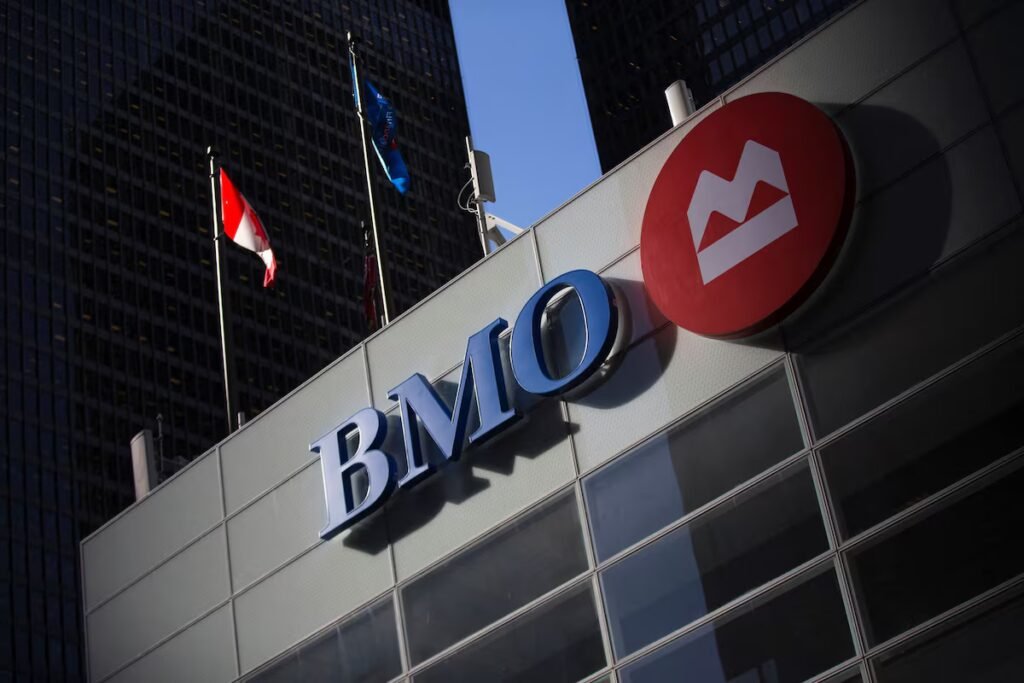

BMO chief risk officer Piyush Agrawal does not expect the upended trade negotiations with the U.S. to cause widespread loan losses.Mark Blinch/Reuters
Two of Canada’s biggest banks are signalling caution over the potential impacts of continuing tariff strife between Canada and the United States, but the chief executive officers say consumers and businesses are adjusting well to an evolving global trade environment.
On Tuesday, Bank of Montreal BMO-T and Bank of Nova Scotia BNS-T reported third-quarter profits that topped analysts’ expectations even as tariff concerns continued to weigh on loan growth. Over the past year, senior bankers have said that certainty on a trade deal with the U.S. is critical for Canada’s business, and expressed confidence that the two countries would ultimately recognize their long-standing economic ties.
Over the weekend, Prime Minister Mark Carney halted trade negotiations and U.S. President Donald Trump imposed new, 50-per-cent tariffs on about $28-billion worth of Canadian goods. Canada announced its own countertariffs on U.S. imports on Tuesday, set to begin on Sept. 8.
Investors betting Canadian banks will continue to book robust profits
“On the trade front, the Canada-U.S. relationship is going through a period of adjustment, and the uncertainty that brings represents a headwind in both countries for trade-related sectors and domestic affordability more broadly,” BMO chief executive officer Darryl White said during a conference call with analysts.
“The relationship will remain an extraordinarily important one to both countries, but some of the assumptions that businesses have relied on for decades, particularly around the predictability of trade policy, have been tested in the last year and a half.”
BMO is working with clients on assessing investment decisions, supply chain changes, and market diversifications, and that despite the tariff uncertainty, businesses are currently “adjusting very well,” he said.
The turmoil also provides an opportunity for Canada as global businesses and investors look for markets with more resiliency to hedge against an increasingly uncertain environment. Mr. White said the country offers a stable financial system, abundant resources, world-class talent and connections through “the world’s most comprehensive set of free trade agreements.”
Scotiabank CEO Scott Thomson said the Canadian economy has “proven to be much more resilient than expected” since the U.S. first imposed new tariffs last year. He added Ottawa should accelerate its plans to stimulate the economy, remove interprovincial trade barriers and improve approval timelines.
The government could bolster the economy by “getting big things done and continuing to diversify trade while also continuing the great trade relationship we have with the U.S.,” Mr. Thomson said during a conference call. “Of course, there’s uncertainty, but it does feel like a manageable force to get through as a country.”
BMO chief risk officer Piyush Agrawal said he does not expect the upended trade negotiations to cause widespread loan losses.
BMO reports lower quarterly profit but beats estimates, announces share buyback plan
The bank tested its loan portfolios with the most exposure to trade disruption. Less than 1 per cent of its loan book has direct exposure to tariff impacts, and many of those clients are investment-grade borrowers.
Mr. Agrawal said he expects the bank’s fourth-quarter provisions for credit losses – the funds banks set aside to cover loans that may default – to remain at the same level as those reserved this quarter.
Scotiabank CRO Shannon McGinnis said the impact of the tariffs will depend on the scope and duration. Clients directly affected account for less than 1 per cent of the lender’s loan portfolio.
BMO and Scotiabank are the first of the Canadian banks to report earnings for the fiscal third quarter. National Bank will post earnings on Wednesday. Royal Bank of Canada, Toronto-Dominion Bank and Canadian Imperial Bank of Commerce will wrap up the week with earnings releases on Thursday.
Canadian bank stocks have soared this year, outpacing Canada’s stock market and shares of U.S. lenders. Investors have been eager for third-quarter results to help assess whether bank stocks could continue to rise, or if their rich valuations have peaked.
BMO reported lower third-quarter profit but beat analysts’ estimates on stronger-than-expected performance across its businesses as the lender seeks to boost its profitability. The bank has been streamlining its operations and rejigging its balance sheet as part of its strategy to boost its profitability, particularly in its U.S. unit.
BMO’s net income fell 25 per cent from the same quarter last year to $1.75-billion or $2.38 per share in the three months that ended July 31. Adjusted to exclude certain items, the lender said profit rose 19 per cent to $2.86-billion or $3.96 per share, edging out the $3.75 analysts expected, according to data by Bloomberg.
Bank of Nova Scotia beats profit estimates boosted by capital markets and business performance
Scotiabank posted higher profit that topped analysts’ expectations on a boost from capital markets and stronger performance across its businesses.
The bank’s net income rose 17 per cent to $2.95-billion or $2.27 per share. Adjusted to exclude certain items, the bank said it earned $2.28 per share, topping the $2.10 analysts expected.
Canadian banks have been building their return on equity – an industry metric that measures profitability – while downplaying the potential for larger takeovers to drive growth. With rich valuations in their share prices and a wave of consolidation expected among U.S. banks, some analysts are watching for renewed interest in acquisitions.
Mr. White said BMO’s approach to its growth strategy has not changed even though the opportunities for acquisitions have improved.
BMO set a goal to improve its return on equity – a closely watched measure of profitability – to 15 per cent by the end of 2027. In the third quarter, BMO posted adjusted ROE of 14 per cent, up from 12 per cent in the same quarter last year.
“Might we engage in M&A in the U.S.? Only if it meets very strict conditions. We think about it in the category of furthering our strategies around regional density and regional scale,” Mr. White said.
“We wouldn’t look at anything that would delay our ROE promises from a timing perspective.”
Scotiabank has made some investments in the U.S. in recent years. Late last year, the lender took an additional stake in Cleveland-based bank KeyCorp. In May, it struck a deal to acquire Texas-based commercial lender MapleMark Bank as part of its plan to expand its global banking and markets business in the U.S.
Mr. Thomson said he is focused on growing Scotiabank’s businesses organically, but would consider some smaller, tuck-in deals in capital markets and wealth management.
“We could benefit from some U.S. capabilities that connect that whole footprint,” Mr. Thomson said.


More Stories
McCain Foods acquires Indian frozen food company as relations with Canada thaw
NATO innovation exercise puts emerging defence technologies to the test in Nova Scotia
Canadian housing policy wants you to live in shoebox condos in the middle of nowhere