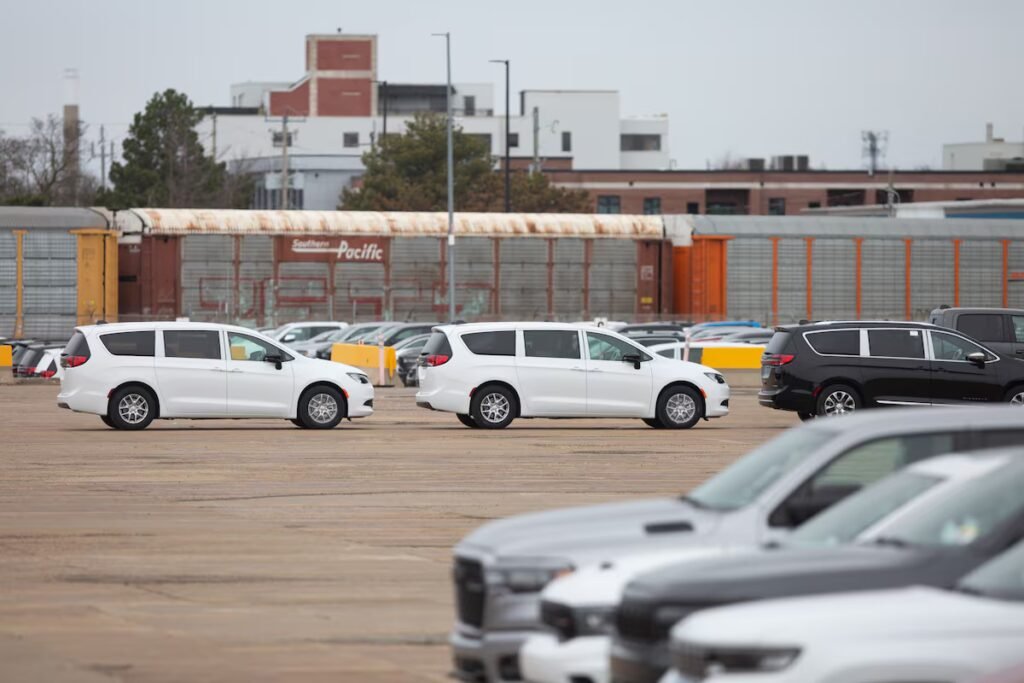

Chrysler Pacificas are parked at Stellantis in Windsor, Ont., in April, 2025. Automotive experts say a 15 per cent auto tariff would prod carmakers in Canada to slow or halt plant upgrades and look to shift production elsewhhere.Dax Melmer/The Canadian Press
The 15-per-cent tariffs on Canadian-made cars being negotiated in Canada-U.S. trade talks would make manufacturing here unprofitable and spur the domestic industry’s decline, experts say.
Canada-U.S. Trade Minister Dominic LeBlanc and U.S. Trade Representative Jamieson Greer are leading talks in Washington ahead of a Friday midnight deadline, seeking to address a slate of trade issues that include dairy, metals, lumber and autos.
U.S. President Donald Trump has said he will impose 50-per-cent tariffs on a range of Canadian imports if no deal is reached by midnight on Friday.
The Globe and Mail is reporting the prospective trade deal would reduce U.S. tariffs on the U.S. content of Canadian-made cars to 15 per cent from 25 per cent, without the exception for domestic or Mexican input that Canada sought.
Automotive experts say that level of tariff would prod carmakers in Canada to slow or halt plant upgrades, and look elsewhere to build new models in countries where they can turn a profit.
Proposed Canada-U.S. trade deal would lock in 15% auto tariffs, sources say
The U.S. content in a car assembled in Canada varies, but is about 50 per cent. This would mean an effective tariff rate of 6 to 8 per cent, which is roughly equal to the labour costs of assembly and, separately, the margin of profit on a vehicle. That means the tariff would saddle carmakers with new costs while destroying profitability.
“None of these carmakers are non-profit enterprises and so over the longer term, they’ll start to look at Canada and think, ‘where can we make more money?’” said Greig Mordue, an engineering professor at McMaster University and a former general manager of Toyota in Canada.
Peter Frise, an automotive engineering professor at the University of Windsor, said it is difficult to predict the impact of the tariffs until the details of the agreement are released. But he said a 15-per-cent tariff would drive up the costs of vehicles for consumers in Canada, the U.S. and Mexico, while slowing investment in Canadian auto plants.
“It can’t be seen as a positive thing,” Prof Frise said. “In an industry where profit margins are typically 6 to 8 per cent, 15 per cent is a lot.”
Mr. Trump imposed 25-per-cent tariffs on Canadian-made cars last year, using Section 232 of the U.S. Trade Expansion Act of 1962 and disregarding the United States-Mexico-Canada Agreement on free trade.
He said the tariffs were designed to bring home U.S. manufacturing and create jobs while applying economic pressure on Canada as he pressed for annexation. He also imposed Section 232 tariffs of 50 per cent on imported aluminum and steel, further driving up costs for U.S. manufacturers.
Mr. Trump has also applied 15-per-cent tariffs on most cars made overseas. The tariffs have cost U.S.-based carmakers billions of dollars, and spurred them to shift production and boost U.S. content.
“That’s what Trump said he was going to do,” Prof. Frise said. “He’s going to damage our economy to the point where it isn’t sustainable any more, and then he could take over. That’s his goal. The thing about Mr. Trump is he usually tells you what he’s going to do.”
Ontario is home to assembly plants owned by five automakers, Honda HNDAF, Toyota TM-N, Stellantis STLA-N, General Motors GM-N and Ford F-N, all of which rely on the U.S. for about 90 per cent of sales. The auto industry employs about 105,000 people in Canada, according to the Canadian Vehicle Manufacturers’ Association.
In Ontario, the tariffs applied last year put the future of automaking into question. One of the province’s largest carmakers, Honda, shelved its $15-billion electric car project; Stellantis moved planned Jeep production to Illinois from its idled Brampton factory, which the Unifor union says is up for sale; General Motors closed its electric van plant in Ingersoll and cut jobs and production at its Oshawa truck plant.
Toyota and Honda, which account for 75 per cent of Ontario’s 1.2 million vehicle output in 2025, lack the capacity to expand in the U.S. for now and have held Canadian production and employment steady. Still, Toyota last year called the Trump tariffs unsustainable.
With auto tariffs a key sticking point, Canada’s industry hangs in the balance
Toyota has said it will expand in Texas and Honda is reportedly considering building a new North American plant that analysts expect will be in the U.S.
It can take two or three years to build a new plant in the U.S., but moving production to U.S. plants that have capacity takes just six months, Prof. Mordue said.
“It doesn’t augur very well for Canada if it’s 15 per cent minus U.S. content,” he said. “I completely get that a deal that has to be made because it’s better than 25 per cent minus U.S. content, but over the longer term, it’s probably not sustainable and decisions have to get made.”
Although auto parts made in Canada remain tariff-free, there are doubts much of the industry will survive the loss of assembly plants, he said.
“That’s not to say all of the parts [factories] will disappear. It’s not to say all of the assembly will disappear, but it’s a long-term challenge,” Prof. Mordue said. “And even companies like Toyota and Honda, which have stayed pretty steady and consistent, will start to look askance.”


More Stories
What retail chain did the Weston family just buy? Take our business and investing news quiz for the week ending Oct. 9
Industry optimistic as Defence Investment Agency pursues new business model, but questions remain
Alberta First Nation taking Ottawa to court over move to fast track Pacific Link pipeline