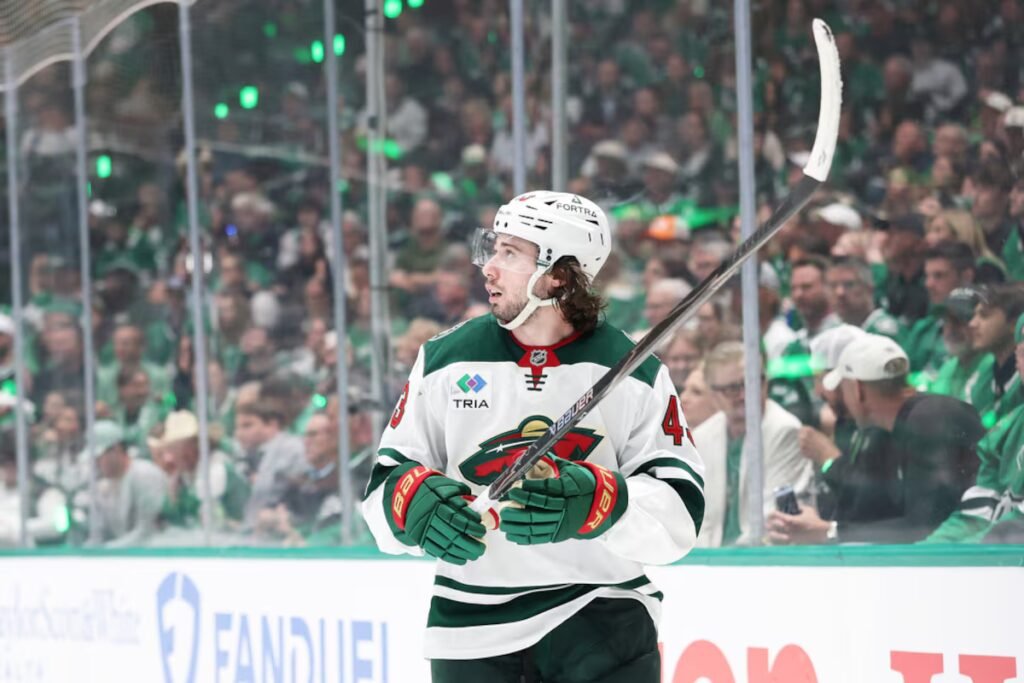

Quinn Hughes is taking his time deciding on whether to sign an extension with the Minnesota Wild, who acquired him last season in a trade with Vancouver.Stacy Revere/Getty Images
The infrastructure of last year’s biggest trade – Quinn Hughes to the Minnesota Wild – was picks and prospects. However, it was the moral framework that mattered. That having been freed from Vancouver, Hughes would do the right thing and commit himself to the Wild for the duration.
Now the time has come for Hughes to do that, and he isn’t. Hughes has only this coming year left on his current deal. He has been extension eligible for six weeks, and nothing’s happened.
Someone has gone so far as to leak his prospective deal – three years at US$18-million a season. That’s juicy enough that it would make him the highest paid defenceman in the NHL, but short enough that he can jump back into the market when he’s 30.
It is, to the NHL’s long-standing way of seeing things, better than a fair offer. It’s a deal no team player, no good guy in the room, would ever turn down. Except Hughes apparently has. At the very least, he hasn’t jumped at it.
Over in Colorado, a similar situation. The other best defenceman in the league, Cale Makar, has one year left on his deal. He is also extension eligible and it’s crickets.
Monday Morning Halfback: Jays, FIFA and sports villains highlight a down-time in the sports calendar
Doesn’t Makar love the Avalanche? Isn’t he grateful for everything they’ve done for him?
It is as if hockey players have begun to disconnect themselves from the league’s hive mind, and develop thoughts, even desires, of their own. The basis on which the system has operated for the last few decades is beginning to come apart.
This is all being driven by a post-pandemic spike in the salary cap. The money tap has been turned on for a while, but the Philadelphia Flyers were the first to make use of it.
Their five-year, US$90-million offer sheet to Anaheim’s Leo Carlsson started the rush. It’s a goofy amount of money to offer a player who is probably very good, rather than great. But what were the Ducks going to do? Let Carlsson go? That would be giving up and starting over.
Anaheim did the only thing it could and matched the Flyers’ offer. For a few days, Carlsson was the highest-paid player in NHL history.
Leo Carlsson, centre, got the big-money ball rolling when the Philadelphia Flyers forced the Anaheim Ducks to match their lucrative contract offer to him this off-season.Scott Strazzante/The Associated Press
In an interview after everything had played out, the first question Carlsson got was, “Why did you sign the offer sheet?”
I don’t know. Because of capitalism?
Can you imagine an NFL quarterback being asked this question? Or a soccer star? ‘Why did you accept money to do work, when you could have done the same job for much less, which would have really helped out the team, as well as the billionaire who owns it?’
Post-Carlsson, it has occurred to other, better players that the house is holding a lot more money than it has traditionally paid out, and they would like as much of it as possible. It has simultaneously struck them that their long-standing tradition of avoiding public awkwardness over dollar figures has only benefitted one side in the negotiation.
Add to this the new fear of getting rich and still getting it wrong.
In 2022, Nathan MacKinnon signed a deal that pays him an average of US$12.6-million a year. That’s fine. It’s the term that looks terrible now – eight years.
Next year, MacKinnon will make two-thirds of what Carlsson does. When Carlsson’s deal runs out, he will still be a kid. When MacKinnon’s is finished, he’ll be well into his Robaxacet years.
How do you think MacKinnon’s contract is going to look in two more years? If the cap keeps rising, MacKinnon is going to be earning as much as a third-line centre on a team that can’t control itself.
Cale Makar, like Hughes, has an expiring contract that the Avalanche would like to extend as soon as possible. The defenceman is yet to put pen to paper.Matthew Stockman/Getty Images
A person with a healthy perspective on life wouldn’t bother caring. I mean, rich is rich. But professional athletes care. They care a lot.
No wonder no one wants to jump into anything. This summer was nothing like last summer. What if next summer is the same?
While the best players begin to practice financial self-care, the teams are coming to terms with the fact that highly paid stars often function more like anchors than sails. This realization has been crystallized by the Carolina Hurricanes. Nobody on the Stanley Cup champions makes more than US$10-million a year.
Carolina would be the template, but for one thing – nobody cares about a team full of anonymous widgets. Name one thing that stands out to you about the Hurricanes. I defy you.
That’s Hughes’s real lever. He’s an attention magnet. As long as you have that guy on your team, people will talk about you.
It’s the same reason the Leafs cannot untether themselves from Auston Matthews, no matter how poorly he treats them. Matthews has become the Leafs’ whole brand. What amount of money would you pay to keep that intact? Just about any, I would imagine. Eventually, Minnesota will realize this.
Andrew Willis: The Maple Leafs will haunt Larry Tanenbaum
In the interim, it’s logical for Hughes and Makar to extend their negotiation period for another year. By then, who knows what the rate for future Hall of Fame defencemen will be – $US20-million a year? Twenty-five?
If that sounds crazy to you, what would you have said about Carlsson’s deal six months ago? Crazy is the new sane.
Whatever Hughes asked for, teams would line up, even if it hobbled their championship chances. Because imagine the industry-wide jolt of getting that guy? For a week at least, you’re a marketing genius.
The same mania that is driving the AI boom – ‘Things can only get better’ – is underwriting every sports deal these days.
For a long time, through a combination of policy and culture, hockey was walled off from that impulse. Players did the right thing, stayed when they were warned and left when they weren’t. That era isn’t over yet. But the end is in sight.


More Stories
Elks score fourth-quarter TDs to down Ticats 27-12
Olivia Smith scores late equalizer as Canada salvages 1-1 draw with Denmark
De Goede leads Canada into England rugby rematches