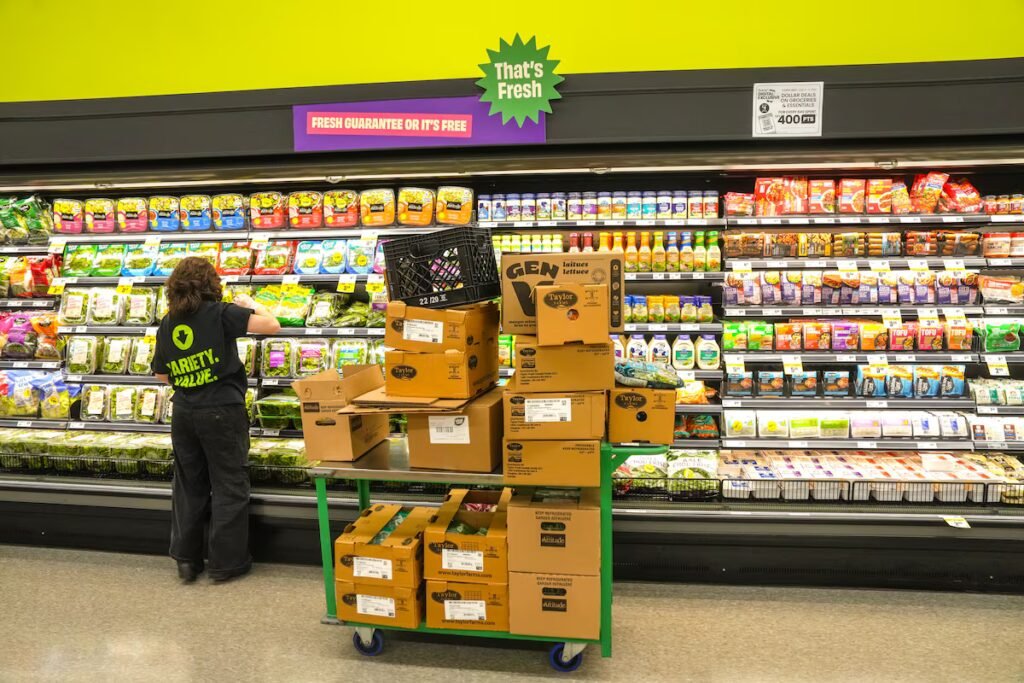

A store employee fills a produce shelf at a FreshCo grocery store in Brampton, Ont.Chris Young/The Canadian Press
We signed up for a Costco membership several years ago – for one year – and I used to make this quip about the savings: We used to spend $120 dollars on food to fill our organics green bin. With Costco, we can fill the bin for just $80.
It’s a joke! But there was an element of truth to it. We often allowed our food to expire, then tossed it based solely on the date on the packaging.
These days I’m trying to be a better person, and saving money on wasteful habits is a big part of this transition. So, I’m now looking at the best before dates applied to most food packaging as more of a guideline, often to be ignored.
I say this as I nibble on a snack of tortilla chips dipped in store-bought hummus with Aug. 27 stamped on the plastic lid – meaning that the hummus “expired” nearly two weeks ago. If I don’t finish the article, you’ll know this was a bad decision.
But if I do finish the article? The savings are all mine, and the world has one less tub of expired hummus to deal with.
I’m not advocating extreme frugality here or taking what I see as unnecessary risks with my health. I’m merely basing my behaviour – loosely – on advice that I’ve been picking up over the years from consumers and articles.
I consume things like eggs, yogurt and milk several days beyond their best before dates, if they look okay. Same goes with leftover meals in my fridge. If frozen food remains frozen, it’s probably okay.
If something smells funky, I toss it. My track record: zero food poisoning episodes.
According to Second Harvest, the food rescue organization, Canadians produce more than 8.8 million metric tonnes of what it calls “avoidable food waste” each year, which is especially alarming when you consider widespread concerns over the rising cost of groceries.
Some 23 per cent of this waste comes from date-coding, where we toss expired products based on best before dates. This waste is valued at more than $12-billion a year.
To be clear, the experts are not suggesting you must accept my invitation to share my hummus. But for shelf-stable products, which can be safely stored at room temperature for long periods, there may be more wiggle room.
The Canadian Food Inspection Agency notes that a best before date is not the same as an expiration date: “You can buy and eat foods after the best before date has passed,” the agency says on its website.
“However, after this date has passed, the food may lose some of its freshness, flavour and nutritional value. Its texture may have also changed. For example, vitamin C content in juice may decrease after the best before date.”
Similarly, dates attached to frozen food are not necessarily reminders to toss that bag of frozen peas. According to the U.S. Department of Health, food stored continuously at -18 degrees Celsius or below can be kept indefinitely.
I know the days are numbered for my hummus, but so far so good. What’s your approach to best before dates? Let me know at dberman@globeandmail.com.
Subscribe to the On Money newsletter
David Berman’s personal finance reading list
Global bond selloff extends as rate hike expectations grow
Government bond yields are soaring to multiyear highs as investors grow nervous about rising inflation and huge government debts. For anyone with fixed income in their portfolios, this can be painful.
Bond yields are surging globally but why aren’t equities falling?
Just to be clear, Canadian bank stocks have retreated, as have some dividend powerhouses such as pipeline stocks. But the point is valid: Major equity benchmarks remain healthy, and dividend-generating stocks remain well above levels of a few years ago, when bond yields also surged.
Young people are obsessed with this simple retirement-savings formula
It is something called Coast FI, where the letters stand for financial independence. Basically, people still in the workforce calculate how much they need in savings to fund a retirement perhaps years or decades down the road. Once they reach that amount, and assume steady compounding, they coast (for subscribers to The Wall Street Journal).
Chart of the day
Trump’s push to isolate Canada falters as foreign investors start to buy in, writes Tim Shufelt in this piece.
New products that caught my eye
It’s probably too late to recommend something to help with the packing process for university. But next year – or anytime you need to haul a lot of clothes somewhere − keep TICONN Extra Large Moving Bags in mind. I was impressed with how much they can hold and how nicely they stack in a car, given that they’re polyethylene cubes. You can get six for $42.99 on Amazon (in blue, but does it matter?). I’m apparently not the only impressed parent: The product’s 43,000 reviews average 4.7 stars.
In the social sphere
Watch
If you had to pick a river bank to search for old treasures – and the odd Roman shoe – you could do worse than the muddy banks of the River Thames in London. “Mudlarkers,” who are licensed to probe through thousands of years of sediment armed with little more than gloves and gardening tools, are discovering amazing things there at low tide. There’s now a waiting list of 10,000 enthusiasts who want to join them. Make that 10,001.
Money-free zone
I was savaged in a recent newsletter for whining about my desire for Kentucky bourbon. Rest assured, I’ve restocked my liquor cabinet with Canadian whisky. And I’m about to add another home-team element for my next Old Fashioned cocktail: replacing sugar with maple syrup.


More Stories
Demands for Stelco, Canada’s maple syrup reserve and Ottawa’s risky mining bet: Must-read business and investing stories for the week of Oct. 24
Cuban envoy asks Canada to renew rejection of U.S. blockade
Italy deploys hundreds of soldiers as protests planned across Europe