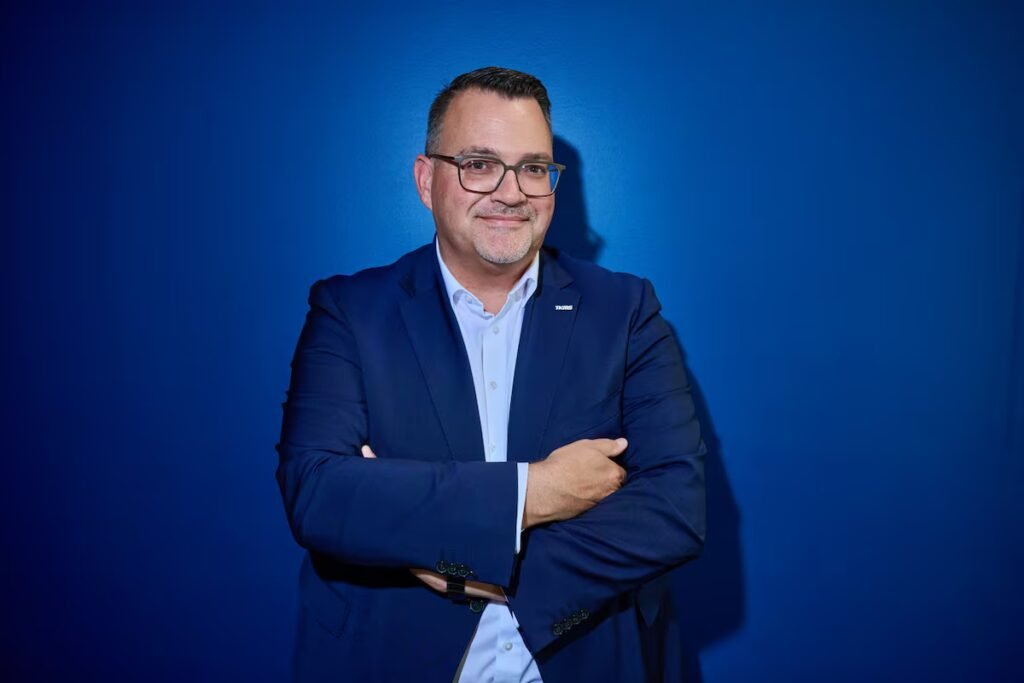

Oliver Burkhard, CEO of TKMS, the German company contracted to supply submarines to the Royal Canadian Navy, said he credits the German government for paving the way to the deal.Kamara Morozuk/The Globe and Mai/The Globe and Mail
The real work is just beginning for Oliver Burkhard, the chief executive officer of TKMS.
In July, the federal government selected the German firm to build Canada’s first major submarine fleet, the culmination of a months-long campaign to secure the contract, and which saw TKMS picked over South Korean defence contractor Hanwha.
Canada wants to buy 12 submarines from Germany in what the countries have marked as a historic deal, tying them together for decades to come. But there’s still plenty of preliminary work to do – including finalizing a contract that, according to Mr. Burkhard, could run up to 100,000 pages.
“We have around 50 people working on that, although not all full-time,” Mr. Burkhard told The Globe and Mail in an interview. “But it is a very, very big contract.”
Mr. Burkhard recently visited Canada to meet with domestic suppliers who were critical to TKMS’s winning bid, marking his first visit since the July announcement. While the visit was an occasion to celebrate, months of negotiations await.
Opinion: A NATO submarine partner: Why Canada chose Germany
TKMS and the Canadian Defence Investment Agency have to agree on the commercial terms of the contract. And the governments of Canada, Germany and Norway, which was part of the TKMS bid, must agree to conditions that include delivery dates of the first submarines. If Germany and Norway accept delays for their own ordered submarines, some of which are already in production, Canada could move up in the waiting line and get one as early as 2033.
Mr. Burkhard wants to finish negotiations around the price and specifications for the submarines by the end of the year. Other projects, such as building ports for maintenance or co-operating with a Canadian company on the assembly of torpedoes, are contingent on this agreement.
“The commercial contract for up to 12 submarines already exists in a way, because of the contracts with Norway and Germany,” he said, adding that Canada now has to decide if it wants to take over this existing contract or to what extent it wishes to negotiate.
At the same time, TKMS has to continue finalizing the dozens of agreements made with Canadian companies in the months leading up to Prime Minister Mark Carney’s announcement in July, as the German firm sought to sell Ottawa on positive economic spinoffs for local firms. Among those is an agreement for co-operation with CAE Inc. for naval training and simulation, an agreement with E3 Lithium Ltd. for critical minerals supply, an order already placed with Valbruna ASW Inc. for special amagnetic steel supply and a contract with Cohere Inc. for the deployment of their artificial intelligence in the submarines.
Canada has chosen Germany’s TKMS for its submarine fleet. Here are its existing partnerships
In addition, “I wouldn’t underestimate our plans with Isar Aerospace,” Mr. Burkhard said, referring to the idea of building a satellite launch site in Nova Scotia with the Bavarian-based startup.
During the bidding campaign, TKMS and Hanwha frequently sweetened their bids. The government pushed the competitors to improve their bids “until the very last minute,” Mr. Burkhard says. The mood could have soured, he says. Still, the executive was impressed with Canada’s determination. From a request for proposal until the decision, only eight months passed. “That is lightspeed. We have never seen this.”
Mr. Burkhard credits the German government for paving the way to a deal. Politicians from Berlin have been the most avid promoters of TKMS and the submarine deal. “They made no visit to Canada where this hasn’t been talked about.”
For Germany, it is a remarkable shift. Not long ago, politicians avoided any ties and proximity to the defence industry. Mr. Burkhard recalls a situation in 2016, when Australia decided to buy 12 submarines from France, leaving TKMS empty-handed: “Twenty-four hours prior to the announcement the entire French cabinet flew into Australia,” Mr. Burkhard recalls. He joked that Germany’s notoriously strict export control office, BAFA, was more widely known in other countries than Oktoberfest.
But much has changed since Russia launched its full-scale invasion of Ukraine in 2022. Today, German officials of almost all political stripes like to share pictures of their visits to ammunition factories and talk about the economic importance of the defence sector. They are keen to facilitate deals in international markets, as with TKMS.
Opinion: In Australia, Canada’s submarine procurement gets a ‘good onya’
“I was really thinking: What happens if we don’t win over Canada, given the commitment that the German government has demonstrated?” Mr. Burkhard considered whether the German government would refrain from boosting the industry abroad if the bid was unsuccessful.
The stakes were high – not only because of the size of the deal, but also because Hanwha could have emerged as a favoured supplier for other Western countries.
But choosing a submarine builder from within the NATO alliance was a key consideration for the Canadian government. “We made the right decision for Canada. We made the right decision for NATO,” Mr. Carney said in July.
Still, Hanwha making the cut is an idea that Mr. Carney has not quite dismissed yet, referring to the company as a “reserve supplier who’s excellent” and who “submitted a very competitive bid.”
The message is clear: It is on Mr. Burkhard to live up to the promises he made.
“It is a very big investment for Canada, they are spending many billions,” he said. “This is why we feel committed every day to act in a way that this partnership can last for decades.”


More Stories
Canada making progress on defence strategy, but key aspects remain a challenge, industry members say
Former Liberal MP sued by father-in-law, who alleges mortgage fraud and forged signatures
Senate banking committee calls for tax changes to help small- and medium-sized businesses