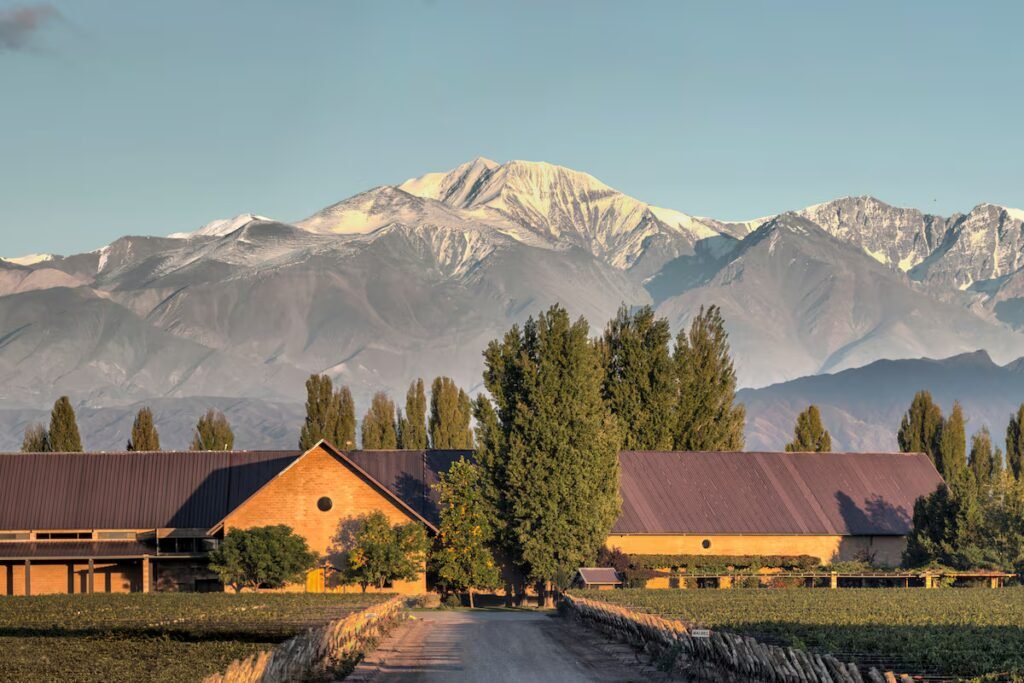

Susana Balbo Wines is the flagship vineyard of Argentina’s first female winemaker.Supplied
It was close to midnight when the plane started its descent into inky blackness. I had left my Toronto home 18 hours ago and was way past tired. But as we inched closer to landing and I was able to make out some features on the ground, my fatigue gave way to the adrenalin of reaching a completely unfamiliar destination.
The lights of the road looked like a necklace laid out against black velvet. This was the legendary Ruta 40, the 5,000-kilometre-long highway in western Argentina that hugs the Andes Mountains down the length of the country.
I was arriving in the city of Mendoza, in the province of the same name, where Route 40 intersects with Argentina’s Wine Route. The Ruta del Vino snakes through the country’s wine-growing regions, whose attractions are flourishing these days. The rocky road of the Argentine peso has been a boon for foreigners, opening doors to high-end dining rooms and accommodations on vineyards, which they might be priced out of in France, Italy or California.
In storybook Wales, a beach day created the perfect twist
Argentina is the fifth-largest wine producer in the world, and more than 80 per cent of this comes from Mendoza province. I was in the right place for my oenophile adventures.
The grape most associated with Mendoza – and indeed with the whole country – is malbec. But the wine I was going to discover was a white. Torrontés is a grape unique to Argentina and once held in such poor esteem it was only deemed usable for lowly table wine. Now this white varietal is being hailed by some as one of the most promising avenues of growth for the wine industry here.
After a restorative sleep, the next day’s first stop was Susana Balbo Wines. The flagship vineyard of Argentina’s first female winemaker, who is also known as the Queen of Torrontés, was a short drive away from Chacras de Coria, the town just outside Mendoza city where I was staying at Balbo’s four-year-old boutique hotel.
Argentina is the fifth-largest wine producer in the world, with more than 80 per cent of that coming from Mendoza province.Relais & Châteaux/Supplied
Emerging from my garden suite that morning was like walking into a Kodachrome photograph, rich with sun-soaked colours – the vast cerulean firmament was the very definition of sky blue.
I had to remind myself I was not in the Rhône Valley, so redolent of southern France was the sentry of shade trees lining the streets. But when the car hit the open road of Route 40, boom: There were the snowy peaks of the Andes, owning the horizon. Aconcagua, the highest mountain in the Americas, is only 120 kilometres away.
This is what makes the viticultural magic I was about to discover: loads of sunshine, cool nights, glacial runoff to water the vines.
The tour ended with a tasting in the wine cellar.Relais & Châteaux/Supplied
I was here in April – autumn in the Southern Hemisphere. The height of the grape harvest was over, and the mood at Susana Balbo Wines was as relaxed as a college campus after exams. The buildings here are not showy with modern architecture, like some vineyards can be. Everything feels designed to give pride of place to the Andes.
The young sommelier leading the tour began with a bit of Balbo’s life story. The winemaker’s first passion was nuclear physics. But the only place offering that training in the 1980s was in Patagonia and, in the uncertain political climate of the day, Balbo’s parents did not want their youngest daughter to move so far away.
So Balbo studied oenology in Mendoza. She was the first woman to graduate from the program, but in her home province, employers were just interested in hiring her as a lab assistant. The only place she could find work as a winemaker was in Salta, a 16-hour drive away in the northern reaches of the country.
Salta offered perfect conditions for the torrontés grape, which was largely unloved. But Balbo saw promise where no one else did. With her knowledge of chemistry, she had a brainwave to treat the grape with an enzyme to break down pectins that made it thick and hard to press.
Susana Balbo Balbo saw promise in the torrontés grape, treating it with an enzyme to break down pectins that made it thick and hard to press.Relais & Châteaux/Supplied
She returned to Mendoza, and, in 1999, acquired the vineyard where I was now standing, and started to build her brand. The tour took us past walls of family photos and industry awards, and ended with a tasting in the wine cellar. The offerings from Susana Balbo Wines ranged from subtle rosé to complex Bordeaux-style red, but what I was most excited about was the torrontés.
As a chardonnay lady, I was sorely in need of a bigger repertoire of whites in my vocabulary. The fragrant and fruity torrontés did not disappoint. Some people say it’s an acquired taste, but I, for one, was delighted to acquire it.
The perfect place to try out my newly expanded palate was over a four-course lunch, with wine pairings, at the vineyard’s restaurant, Osadía de Crear. It was started by Balbo’s daughter, Ana Lovaglio. Working in marketing for the family business, she recognized that all the elements were in place for a natural progression into hospitality.
Aside from the torrontés, the offerings from Susana Balbo Wines ranged from subtle rosé to complex Bordeaux-style red.Relais & Châteaux/Supplied
The next big step came at a time when many places around the world were shutting their doors. In early 2020, with both mother and daughter grounded because of the pandemic, they began planning a boutique hotel on a property they owned in Chacras. It took two years to open Susana Balbo Winemaker’s House and Spa Suites.
The Relais & Châteaux luxury hotel welcomes a maximum of 14 guests – each of the seven suites is a stand-alone, glass-walled bungalow, arranged discreetly behind hedges and greenery around an elegant outdoor pool and patio. The hotel has a lively collection of local artwork and furnishings. There is a steam room in every suite and some have dry saunas, too. But the pièce de résistance in my bungalow, without a doubt, is a deep, egg-shaped stand-alone tub.
The in-house restaurant, La VidA, which was recently awarded a Michelin star, offers a seven-course fine-dining menu. It can be paired with older vintages no longer available on the market.
I did want to explore the town of Chacras. So, after lunch on my second day, I strolled over toward the main square. Again, I had to shake my head and remind myself I was not in France. It felt like déjà vu of Aix-en-Provence or Avignon – until I started chatting to storekeepers and restaurant servers, who were definitely more relaxed than their stereotypical French counterparts.
The in-house restaurant, La Vida, was recently awarded a Michelin star.Relais & Châteaux/Supplied
I loved the brightly painted façades of many businesses – crimson, tangerine and seafoam green – and the playful wall art on shop fronts, like the Dandi grocery’s wine-swilling, tuxedoed rabbit. I hung out on the patio of La Gloria Cantina for coffee and some dulce de leche flan.
Knowing that I would kick myself for skipping the city, on the third day of my visit, I hopped a Cabify – the South American equivalent of Uber – for the 30-minute drive into Mendoza.
I spent a couple of hours walking its leafy boulevards, heading up from the main square to Parque General San Martín, an expansive urban green space. But I found the sounds of a lively city clashed with my slow-travel mindset.
For my last night in paradise, I wanted to hang out on my suite’s private terrace, watching lime-green monk parakeets fussing in the palm trees. The next morning, I was leaving Argentina to continue my oenophile journey in neighbouring Chile.
But rather than hopping on a 50-minute flight to Santiago, I was taking the scenic route: an eight-hour bus trip across the Andes, which had so beguiled me since I landed here.
Travelling along another legendary South American highway, I was going to get up close and personal with the mighty Aconcagua itself, and I could already feel the adrenalin tingle that had started me off on this adventure.
If you go
Rooms start at US$900 a night, and include breakfast, as well as a post-travel mini-massage, welcome drinks and snacks. Longer stays offer more inclusions. All guests can take part in the hotel’s complimentary bath service and yerba maté information sessions.
The writer was a guest of Susana Balbo Winemaker’s House and Spa Suites, and Copa Airlines, which did not review or approve this article. Stories are based on merit; The Globe does not guarantee coverage.


More Stories
Dessert Club is an ode to artist Diane Borsato’s favourite global sweets
Red lentil nuggets make a quick meal or snack
People-pleasing: Why do we keep saying yes when we want to say no?