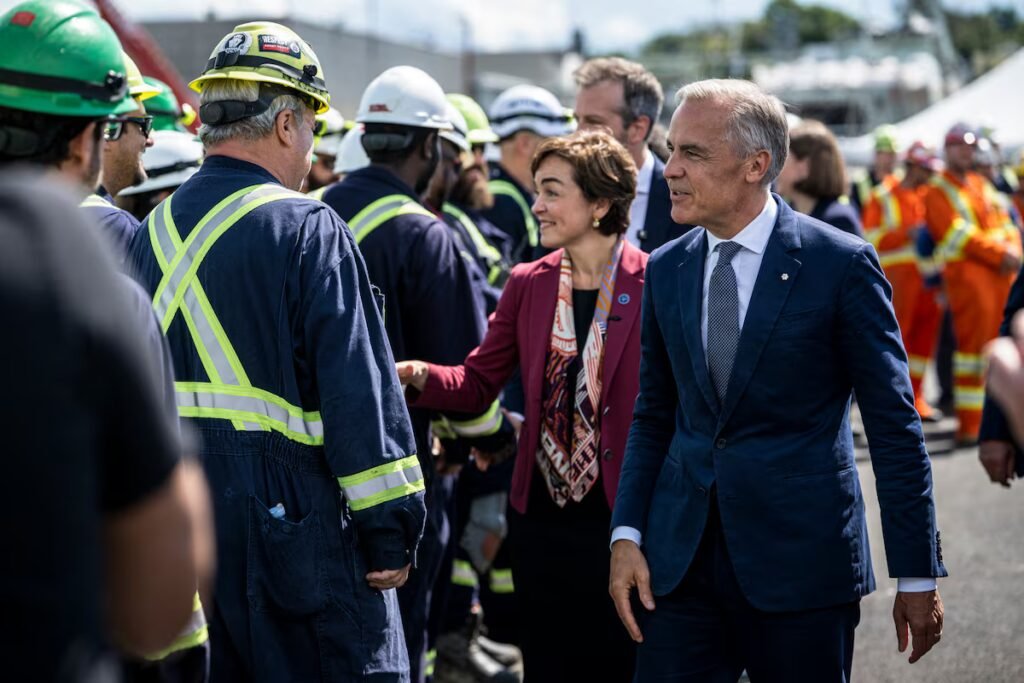

Prime Minister Mark Carney greets workers at Davie Shipyard in Levis, Que., on Tuesday. U.S. President Donald Trump’s administration warned on Sunday that Canada would be “foolish” to think it could win a trade war with the U.S., predicting a “devastating” impact on its northern neighbour.ANDREJ IVANOV/AFP/Getty Images
Canada’s escalating trade war with the United States will hang over a high-powered investment summit in Toronto three weeks from now, raising the stakes for a pivotal pitch to the world’s largest money managers.
The Canada Investment Summit on Sept. 14 and 15 will bring together the largest gathering of top business leaders ever to assemble in the country – perhaps as many as 250, including some of the most influential names in global finance, who collectively manage more than $120-trillion.
Led by Prime Minister Mark Carney and organized with help from two of the country’s largest pension funds, it is framed as a chance to showcase Canada as a destination for foreign capital and to deliver on Ottawa’s promise to attract $500-billion in new private-sector investment within five years.
Ottawa readies tariff-relief plan for businesses
It looked last week as though Canada was close to reaching a trade deal with the U.S. that would have locked in a base level of tariffs on key sectors such as automobiles, steel and aluminum, but also provide clarity about the country’s economic outlook.
Instead, Canada’s near-term prospects look highly uncertain after trade talks broke down, the U.S. imposed new tariffs and Mr. Carney promised to retaliate by matching them “dollar for dollar,” saying the two countries are now in a trade “war.” The situation further escalated on Monday when U.S. President Donald Trump threatened to raise tariffs on Canada’s auto sector on Jan. 1, 2027.
“If you’re an investor, you will have reasonable questions” about the fallout, said Michel Leduc, chief public affairs officer at the Canada Pension Plan Investment Board, which is a co-organizer of the summit and the country’s largest pension fund with $864-billion in assets.
The Public Sector Pension Investment Board, which manages a $321-billion pension fund for the federal public service, Canadian Armed Forces and the RCMP, is the summit’s other co-organizer.
The Canadian political leaders and executives staging the summit will need to be ready with specific answers to questions about how the country’s investment climate is improving, and how that progress can be insulated from trade turmoil, Mr. Leduc said in an interview.
Yet he is one of several sources from the investment sector who said that the expanding tariff battle won’t change the summit’s fundamental dynamic.
Opinion: The U.S. isn’t negotiating trade with Canada. This is a shakedown
The Globe spoke to six sources who are involved in the summit or have knowledge of its planning, but is not identifying them because they are not authorized to speak publicly about the event.
The plan to stage the summit came together at another moment of high uncertainty and rising tensions with the U.S., around the time Mr. Carney gave a blunt speech at the World Economic Forum in Davos, Switzerland, in January.
At the time, Mr. Carney called out attempts at economic coercion without naming the U.S. administration, arguing there had been a rupture in a familiar world order that is “not coming back.”
The summit was, in some sense, an extension of the Prime Minister’s argument, aimed at jump-starting a strategy to build a broader coalition of trading relationships around the world, and attract major new flows of foreign capital to Canada.
Some executives expect Mr. Carney will adopt a similar tone in Toronto, pointing to the erratic trade talks with the U.S. as further proof that investors should diversify their portfolios with investments in more predictable countries such as Canada.
Mr. Carney mentioned the investment summit in his Saturday speech outlining why trade talks with the U.S. broke down. When the world’s largest investors arrive in three weeks, “they’ll find a Canadian economy that has never been more connected or more ambitious,” he said. “We are lowering tax. We are removing barriers and accelerating the transformation of our economy.”
The Prime Minister’s Office did not immediately respond to a request for comment.
The country’s pitch is expected to focus on projects in sectors such as infrastructure, natural resources, electricity generation and defence, as well as advanced technologies such as artificial intelligence, some of which are less reliant on a U.S. customer base to succeed, one source said.
Trade talks collapsed at last minute after U.S. commerce chief pressed for harsher terms, sources say
Another source who has had recent discussions with investors in the United Arab Emirates and Saudi Arabia, before trade talks fell apart, said the biggest concern for many of them is regulatory red tape that bogs down projects, which is a pain point that Canada can control. The source also said those investors mostly expect the Canada-U.S. tensions to be temporary, and are focused on Canadian companies that can export their products and intellectual property to the Middle East and other regions, as well as to U.S. buyers.
For multinational companies such as foreign auto manufacturers that have long valued Canada’s privileged access to the U.S. market when assessing where to build plants and supply chains, however, the rising tariffs will be a clear negative.
There is no realistic way Canada could attract enough additional investment from abroad to offset the economic pain from the punitive tariffs the U.S. has imposed, especially if tariff rates escalate in a tit-for-tat feud, investment executives said.
Even so, “we need to be thinking in those terms,” Mr. Leduc said.
They said the summit is a chance to build momentum toward future growth, especially as Canada’s economic performance appears likely to get worse before it gets better.


More Stories
Toronto robotics startup hopes to expand options for surgical procedures
Canadian investors concerned about future of Thames Water as Britain mulls nationalization
Hitters are winning more ABS challenges in the postseason, and teams are challenging more overall