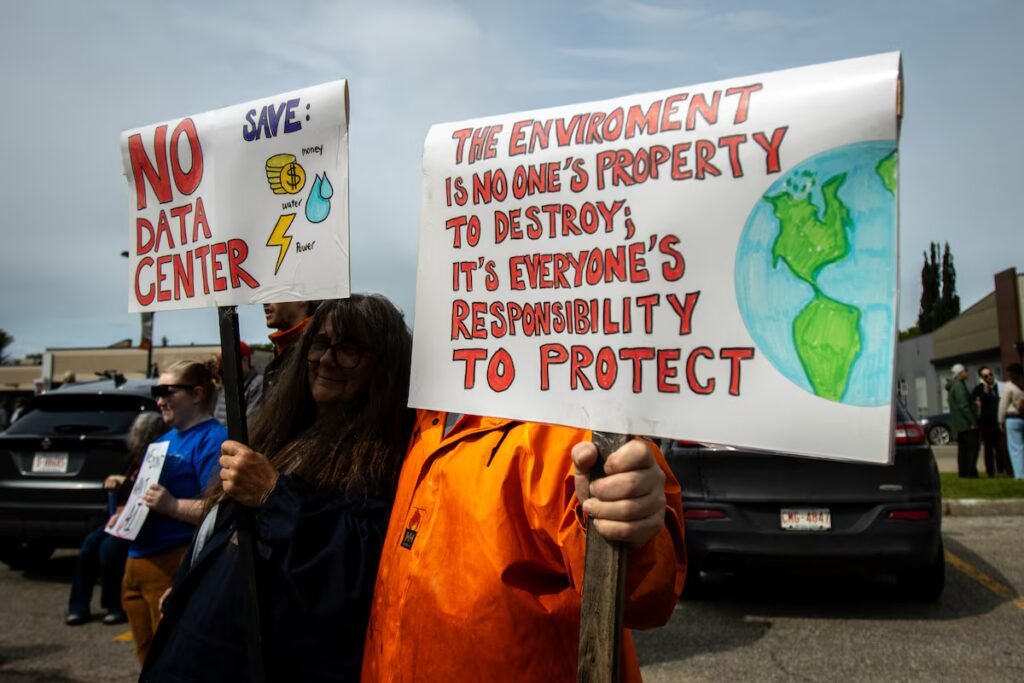

Albertans lift signs at a protest against a proposed Meta artificial intelligence data centre in Morinville Alta., on Aug. 2. An emissions-free generation won’t happen quickly, so the AI companies are taking the path of least resistance – and lowest cost, writes Eric Reguly.Amanda May Erickson/The Canadian Press
Companies that own AI data centres are worth trillions of dollars. The centres’ environmental footprints are enormous. Their demand for electricity and water is voracious and their carbon emission output is surging. It’s time for an AI tax.
Corporations love privatizing profits and pushing the environmental costs onto society, and so it is with artificial intelligence. No wonder that Americans, Canadians and Europeans are turning against the AI industry and the broligarchs who run them. A recent Gallup poll found that 70 per cent of Americans oppose having data centres constructed in their area because of the environmental impact (they also worry about AI-triggered jobs losses and don’t trust AI medical advice).
Majority of Canadians oppose government support for AI data centres, poll shows
As the AI industry expands, the fear and mistrust factors will rise, especially since AI companies are turning to fossil fuels to generate electricity. Yes, they want emissions-free generation – nuclear reactors, solar panels and wind farms – but none of that can be built quickly; nukes sometimes take decades to go from planning to production. A new gas plant can be fired up in three years; restarting a decommissioned plant can take only a few months. So the AI companies are taking the path of least resistance – and lowest cost.
The Financial Times reported this week that 60 of the largest planned data centres to be built by Amazon, Microsoft, Google and Meta would collectively produce more than 100 million tonnes of carbon dioxide a year once they come on stream. It equated the annual emissions output to 27 coal plants or 24 million gasoline cars.
The International Energy Agency says gas generation supplies more than 40 per cent of the electricity used by the existing data centres in the U.S., followed by renewable energy at 24 per cent, nuclear at 20 per cent and coal at 15 per cent. As data centres multiply, gas – the third dirtiest fossil fuel, after coal and oil – will be AI’s main source of additional power, it predicts.
The growth of AI’s energy use has been astonishing. A June report from Berkeley Lab in California said U.S. data centres could gobble up 11.8 per cent of total U.S. electricity by 2030, and the lab isn’t ruling out consumption reaching as high as 15 per cent. In that range, the centres would vie with industrial and residential air conditioning for electricity consumption, which raises the question: As the planet heats up, will there be enough power to keep both homes and data centres cool – and if so, at what price?
The surging demand for electricity makes AI part of the climate problem, and the AI biggies admit as much. If you trawl through Amazon’s sustainability report, you will see that its carbon emissions rose 16 per cent in 2024 over the previous year. As data centres are rolled out, the double-digit increase may become the norm, calling into question the company’s goal of net-zero emissions by 2040. Microsoft’s emissions rose by a quarter over the same period.
Eric Reguly: AI data centres’ voracious thirst for water makes their environmental footprint even bigger
Throwing this much garbage into the atmosphere in the form of planet-warming carbon emissions (never mind the data centres’ unquenchable thirst for cooling water) demands a response, all the more so given the rate of warming.
Heat records are being smashed across Europe this summer and rivers are drying up. Barges in the Rhine, Germany’s economic river highway, are sailing at 80 per cent empty to avoid running aground. The drought and savage temperatures are pushing down crop yields for corn, potatoes, carrots, wheat and other foods. European countries are counting thousands of “excess” deaths, no doubt caused by the heat and the lack of residential air conditioning; a quarter or less of homes in Western Europe have AC.
Editorial: Europe’s burning question
AI cannot get a free environmental ride, especially since the business is routinely taxpayer-subsidized. In the U.S., data centres can qualify for property and sales tax exemptions (usually at the state level), tax credits and cut-rate electricity. An AI tax would help level the public-private playing field.
The main questions are how to apply the tax, at what level and where to direct the proceeds. Various economists and politicians advocate a tax on electricity consumption or carbon intensity, or a revenue-based excise tax. Virginia, home to an ever-expanding cluster of centres, is leading the way. This summer the state approved a small electricity consumption tax specifically for AI centres that is expected to raise US$600-million in the coming year.
The funds from any AI tax could be used to find new jobs for workers made redundant by AI, or to subsidize renewable energy projects or electricity rates for homeowners.
Collectively, the Big Four U.S. AI companies have a market value of more than US$12-trillion, double the size of Germany’s GDP. They can afford an AI tax, but will no doubt fight the idea. A note from Riverford, a British organic farm, summed it up this month in a Facebook post: “As our reservoirs run dry and our crops die, data centres will have plenty of water and energy and leapfrog the planning process … but who dares impede a tech bro?”


More Stories
Russia to supply more than 300,000 tons of diesel to U.S. and global market, Trump says
Pitching in: Fundraising for Princess Margaret Hospital one goal at a time
Interest rates are rising. It’s not clear why. But soon something will break