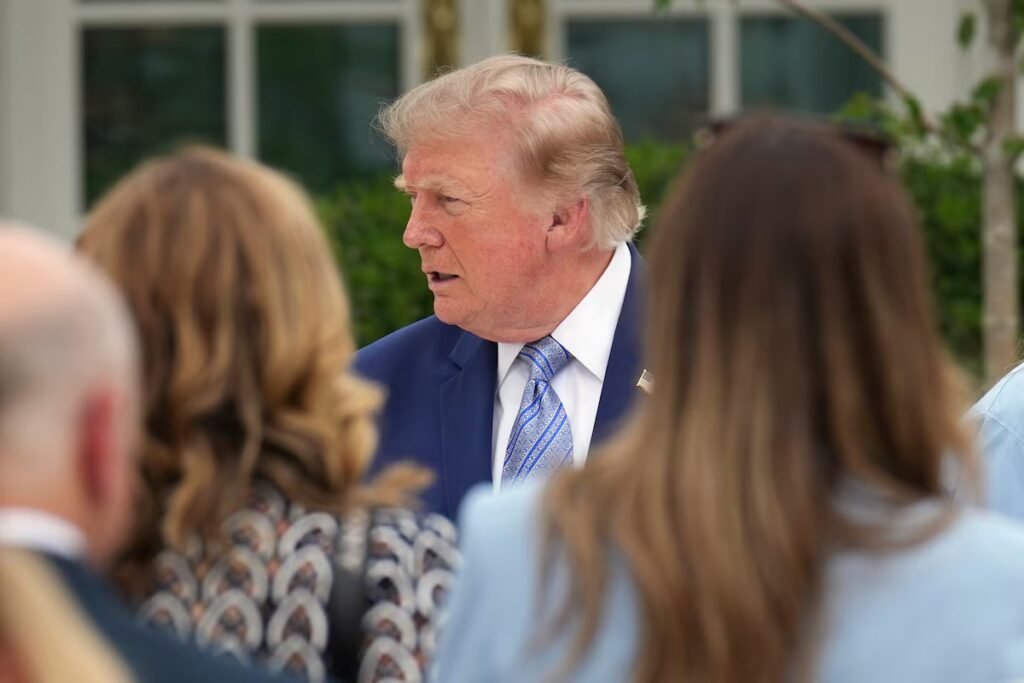

U.S. President Donald Trump doesn’t want freer trade. He has consistently expressed his desire for the opposite, Tony Keller writes.Jacquelyn Martin/The Associated Press
Before you give a thumbs up or down to the unseen and uncompleted interim trade arrangement between Canada and the United States, get your head around the following:
U.S. President Donald Trump has never offered Canada a better trade relationship. That’s not what negotiations are about.
He has not offered a better, freer, easier trade relationship to any country.
The squeeze he put on every trading partner last year was this: Accept something worse than the status quo, or I’ll hit you with even worse.
He threatened higher tariffs, more trade restrictions and less free trade – while proposing that, if countries signed on the dotted line, the new tariff walls would be somewhat less high.
Not lower. Less high.
Explainer: Trump made new trade deals with countries around the world. Here’s how they played out
Remember the movie Dumb and Dumber? Trump trade policy is Bad or Badder.
Threatened with Badder, most countries settled for Bad. They accepted higher tariffs on their exports to the U.S., and promised not to retaliate.
Two countries pushed back: China and Canada.
Ottawa would obviously prefer to be negotiating the removal of Mr. Trump’s suite of existing and threatened trade walls. But he wants trade negotiations to be about the height and breadth of his walls, not their removal.
Mr. Trump doesn’t want freer trade. He has consistently expressed his desire for the opposite.
To avoid Badder, namely high U.S. tariff walls, most of the rest of the world signed pieces of paper saying that they accept Bad – medium-height U.S. tariff walls.
Carney tried to ‘out-tough’ Trump in trade negotiations, Vance says
That’s why the issue for Ottawa, in dealing with this second incarnation of the Trump administration, has never been whether Canada can get a better deal than the pre-2025 status quo.
That status quo, under the United States-Mexico-Canada Agreement and trade deals stretching back to 1989, involved no or very low tariffs on nearly everything shipped from Canada to the U.S., and vice versa. The tariff rate on almost everything moving across the border was zero.
Free trade, in other words.
How much worse than that should Canada agree to? Threatened with Badder and Baddest, should we agree to merely Bad?
Or should we tell the Trump administration: Do what you will, but we’re not signing a piece of paper saying that we’re okay with it?
The answer comes down to how not-so-bad is Bad, versus how much worse is Badder.
Given that there was no final text of any prospective agreement as of Thursday afternoon, I can’t offer an answer. Not yet.
Opinion: Trump thinks tariffs will tear Canada apart. The evidence proves him wrong
But as you judge the government’s work, and its exceptionally difficult task, keep in mind that Ottawa’s talks with Washington have never been about securing or improving what was the world’s best trade deal.
Turning a historically excellent trade relationship into an even better one is what Canada wants, obviously. But it’s not on the Trump menu.
Talks have instead been about trying to get the least-bad outcome.
This has been a negotiation about limiting the damage to Canada, rather than reaching for gains. It’s been about minimizing the level of subtraction.
Since the U.S-Canada Free Trade Agreement went into effect in 1989, the rule between the two countries has been tariff- and barrier-free trade, with a short list of exceptions.
That became the norm across the world. International trade talks were always negotiations over which old trade walls to take down, not which new walls to put up.
The Trump administration has turned history on its head. Tariff-free trade with the U.S. has gone from rule to exception.
What Trump’s new tariffs would mean for Canada’s economy
Tariff negotiations used to be about Low or Lower. With the Trump administration, it’s about High or Higher.
Canada obviously wants to be the exception to America’s new protectionist ways. We want to keep the pre-2025 status quo of zero tariffs on almost everything.
However, while the Trump administration has signalled that it’s open to treating Canada as an exception, it clearly wants to avoid going so far as giving us a full exemption.
Washington almost certainly will not return its northern tariff wall to where it used to be, which was basically zero.
But will it agree to make the wall considerably lower and narrower than the trade walls facing the rest of the world?
And will that barrier be low enough – even if it’s not as low as the pre-2025 status quo – that most Canadian exporters, including integrated continental industries like cars and car parts, can live with it?
Until we get the final text of the pending interim agreement, and see what comes of future USMCA negotiations, we can’t know the answer.


More Stories
Russia to supply more than 300,000 tons of diesel to U.S. and global market, Trump says
Pitching in: Fundraising for Princess Margaret Hospital one goal at a time
Interest rates are rising. It’s not clear why. But soon something will break