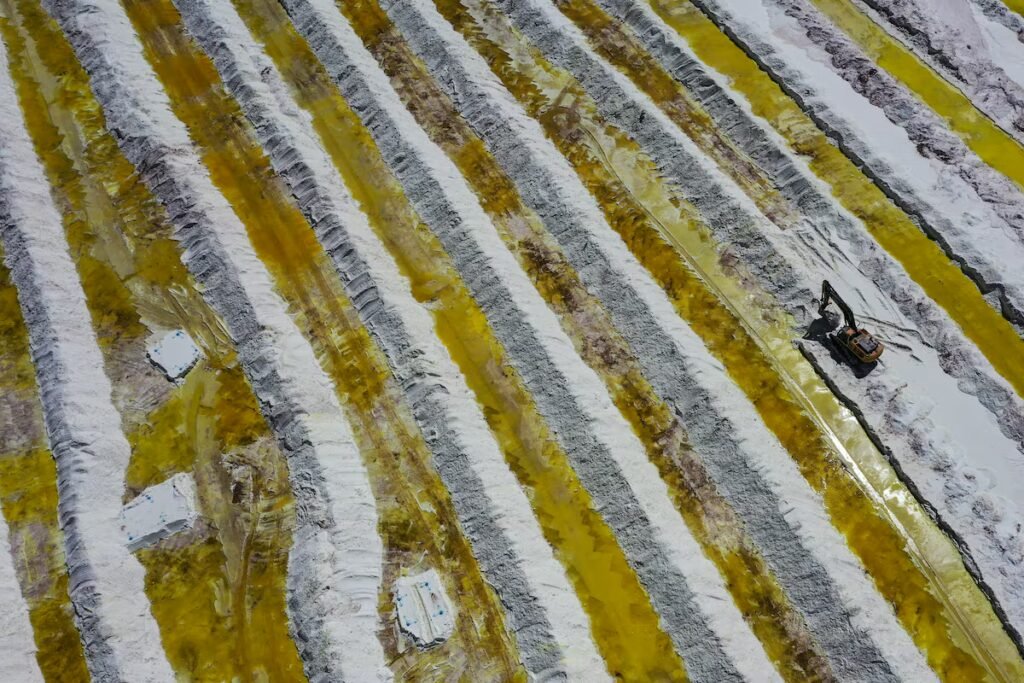

Aerial view of brine ponds and processing areas at a lithium mine in the Atacama Desert, Calama, Chile, in September, 2022. Lithium Chile Inc. is fighting Ottawa’s decision to review its planned sale of Argentine subsidiary Argentum Lithium SA to China Union Holdings Ltd.MARTIN BERNETTI/AFP/Getty Images
Calgary-based Lithium Chile Inc. LITH-X is fighting the federal government’s decision to review a planned US$175-million sale of an Argentinian project to a Chinese company, a move the mining company says creates uncertainty in Canadian capital markets.
On Monday, Lithium Chile revealed that the Industry Ministry served notice it would review the proposed sale of an Argentina-based subsidiary, Argentum Lithium SA, to China Union Holdings Ltd., which is based in Shenzhen.
The two companies announced the transaction eight months ago. Ottawa has the power to block the deal.
The federal government launched the review over national security concerns, Lithium Chile chief executive officer Steve Cochrane said in a press release. He said the ministry’s decision has “consequences extend beyond Lithium Chile, creating uncertainty for shareholders and transaction counterparties and undermining confidence in the predictability of Canada’s capital markets.”
A spokesperson for Industry Minister Mélanie Joly had no immediate comment on the matter.
Lithium Chile, which is listed on the TSX Venture Exchange, and China Union remain committed to the deal and are negotiating with the government. Mr. Cochrane said the companies’ position is that the sale falls outside the Canadian government’s jurisdiction.
He said the timing of the Industry Ministry’s notice “raises serious concerns regarding regulatory certainty, procedural fairness and the ability of shareholders to rely on a transparent regulatory process.”
In December, Lithium Chile announced it would sell China Union its stake in Argentum, which owns a 62.2-per-cent interest in another Argentine company developing a lithium project in salt flats located in northwestern Argentina. Mr. Cochrane said Argentum has no assets, employees or operations in Canada.
“We were transparent from the beginning,” Mr. Cochrane said. “We publicly disclosed the transaction, proactively notified the federal government, clearly explained our jurisdictional position and continued to keep our shareholders fully informed.”
The Canadian government is reviewing the Lithium Chile transaction at the same time it negotiates a trade agreement with the United States that could include a right of first refusal on Canadian critical mineral production for the American government.
Last September, the U.S. government took an equity stake in Vancouver-based Lithium Americas Corp. LAC-T, which is developing a mine in Nevada, as part of a series of investments in critical mineral producers, tech and defence companies.
Lithium Chile has a $95-million market capitalization. The miner plans to use cash from the Argentum sale to fund development of its 11 properties in Chile. The projects in Chile have reserves that are expected to produce lithium for 20 years or more.
The Calgary miner’s structure, which keeps its Argentina project at arms-length in a separate subsidiary, may have drawn the attention of Canadian government officials concerned that domestic companies are deliberately creating organizations that avoid regulatory scrutiny, according to lawyers who are not working on the Lithium Chile transaction.
They said any large transaction involving a Canadian miner and a Chinese company draws government scrutiny.
The Canadian government has blocked deals between domestic and Chinese miners in the past, but the transactions involved assets in Canada. In 2020, Ottawa nixed China state-controlled Shandong Gold Mining Co. Ltd.’s takeover of junior gold miner TMAC Resources Inc. because of concerns about security around TMAC’s Arctic mine site.
The federal government has approved Chinese takeovers of Canadian miners with foreign assets. In 2022, the industry ministry signed off on the $960-million acquisition of Neo Lithium Corp. NTTHF by Chinese state-owned firm Zijin Mining Group Ltd. ZIJMF.
The federal government has targeted Chinese investment in Lithium Chile in the past.
In 2022, Ottawa forced a Chinese mining company, Chengze Lithium International Ltd., to divest its 19-per-cent stake in Lithium Chile. The move was part of a federal crackdown on Chinese ownership of junior miners that led to the sale of stakes in three Canadian companies.
At the time, former industry minister François-Philippe Champagne said: “While Canada continues to welcome foreign direct investment, we will act decisively when investments threaten our national security and our critical minerals supply chains, both at home and abroad.”
The domestic mining industry is built on merger and acquisition activity, with junior companies such as Lithium Chile finding properties, then selling them to larger players, including foreign miners.
In the first three months of this year, Canadian base metal and precious metal miners did 190 transactions worth $16.3-billion, according to data compiled by investment bank Crosbie & Co., the most M&A traffic of any sector, which saw a total of 672 deals announced.


More Stories
Banks embrace AI, but need to show tech is benefiting bottom lines, report finds
CPPIB forms joint venture with AT&T, BlackRock’s GIP to expand fibre-optic network
Nancy Southern sees Emera deal as a win-win for ATCO