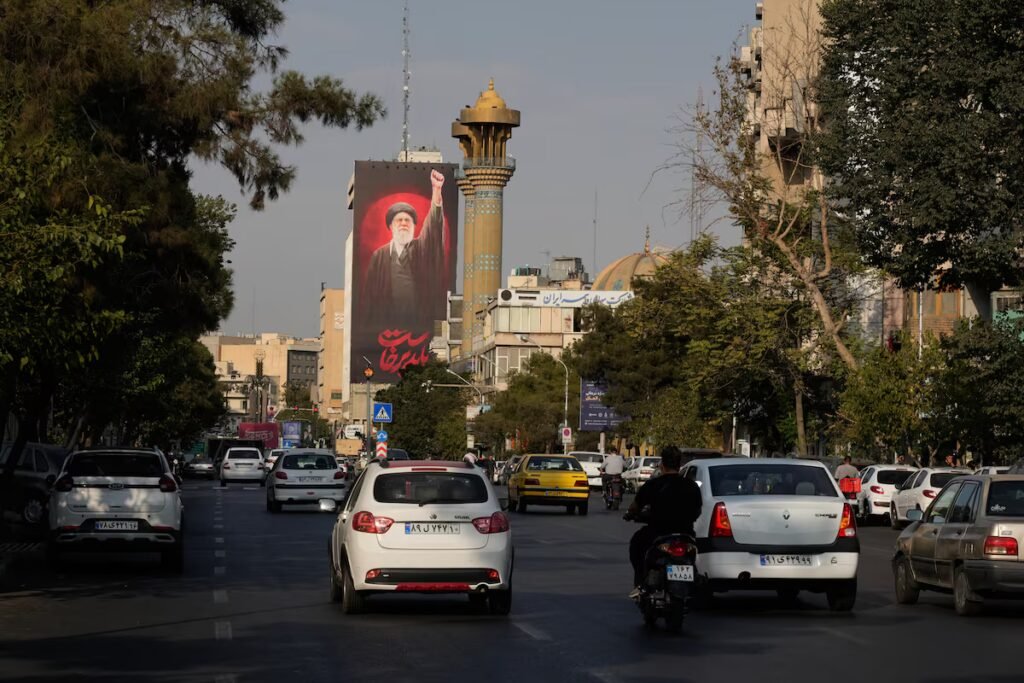

A billboard with a message that reads in Farsi: ‘We must rise up’ and an image of the late Iranian Supreme Leader Ayatollah Ali Khamenei towers over downtown traffic in Tehran, Aug. 15.Vahid Salemi/The Associated Press
The United Arab Emirates suspended all trade with Iran on Wednesday after it said it had come under renewed fire from the country – a move that will further isolate the Islamic Republic, which is suffering under American sanctions and a blockade.
Incoming ballistic missile fire triggered nationwide warnings Tuesday night for UAE residents to seek shelter, the first time in weeks such an alarm had sounded.
Early in the conflict, the UAE regularly came under intense fire from Iran, and most trade between the countries, which had once been important trading partners, ground to a halt. In late June, as hostilities eased, at least some maritime trade resumed, Iran’s state-run IRNA news agency reported. But it was not clear how much trade there was more recently.
UAE accuses Iran of firing missiles. Tehran denies that
Following the news that two ballistic missiles had been fired toward the UAE, both of which splashed down in the Persian Gulf late Tuesday, the Foreign Ministry said that while it remained committed to “dialogue, co-operation and regional integration,” it had decided to impose the punitive measures.
“In light of regional escalations that undermine regional and international peace and security, all trade, commercial exchanges and financial transactions with Iran have been halted until further notice,” the ministry said in a statement.
The UAE’s Defence Ministry said assessments showed that the missiles targeted maritime traffic. It was not clear whether they directly targeted Emirati ships or the country’s territorial waters.
Iranian Foreign Ministry spokesperson Esmail Baghaei denied that Iran had launched any missiles toward the UAE.
As part of Iran’s efforts to maintain a stranglehold over the Strait of Hormuz, it has regularly attacked ships attempting to use the waterway, including four tankers owned by Abu Dhabi’s state-owned ADNOC oil and gas company over the past two weeks. None of the attacks caused any injuries, but they brought harsh condemnation from the UAE and others in the region, including Kuwait and Bahrain.
Vessels near the Strait of Hormuz, as seen from Musandam, Oman, Monday.Stringer/Reuters
Since the beginning of the conflict nearly 20 ADNOC vessels have been attacked by missiles and drones in the Strait of Hormuz, killing one person and wounding another 20.
Iran’s ability to control traffic through the Strait of Hormuz, through which a fifth of traded oil and natural gas passed during peacetime, has proved its biggest strategic advantage in the war. While the U.S. and Israel – which launched the war on Feb. 28 – have given various aims, including toppling Tehran’s government and ending its nuclear program, the conflict has devolved into a fight over the strait.
During the war, Iran has launched hundreds of ballistic missiles and thousands of drones in strikes that Tehran said were targeting American assets but hit buildings in Dubai and Abu Dhabi, Dubai’s commercial airport, ports and energy infrastructure.
Iran has accused the UAE and other U.S. allies in the Gulf of facilitating American military attacks on Iran, and Iran’s Chief of Staff Gen. Ali Abdollahi on Wednesday issued a new warning to “countries on the southern shores of the Persian Gulf.”
“Any assistance or facilitation provided to the aggressor U.S. military amounts to participation alongside U.S. military forces,” he said in a statement distributed by Iran’s semiofficial Fars news agency.
UAE embargo could put new pressure on Iran
Before the war, the UAE was one of Iran’s biggest trade partners, providing more than 30 per cent of its imports valued at some US$21-billion, according to the World Trade Organization’s latest figures from 2024. It was the destination for nearly 13 per cent of its exports worth some US$7-billion.
The Emirati announcement comes as the U.S. prepares to apply new economic pressure on Iran.
Speaking last week, Treasury Secretary Scott Bessent said the measures would be a combination of economic isolation and the continued American blockade of Iranian ports.
The economic pressure follows the intense bombing campaign that targeted industrial and civilian infrastructure in addition to military targets. Already the International Monetary Fund forecasts inflation of nearly 70 per cent this year in Iran and an economic contraction of 5.4 per cent. Meanwhile, its rial currency has hit record lows.


More Stories
MBA student, 33, sacrificed having fun to buy a Vancouver condo in her mid-20s
Give bees a chance: Molagri’s plan to solve global food insecurity
Quebec has second thoughts on oil and gas development bans