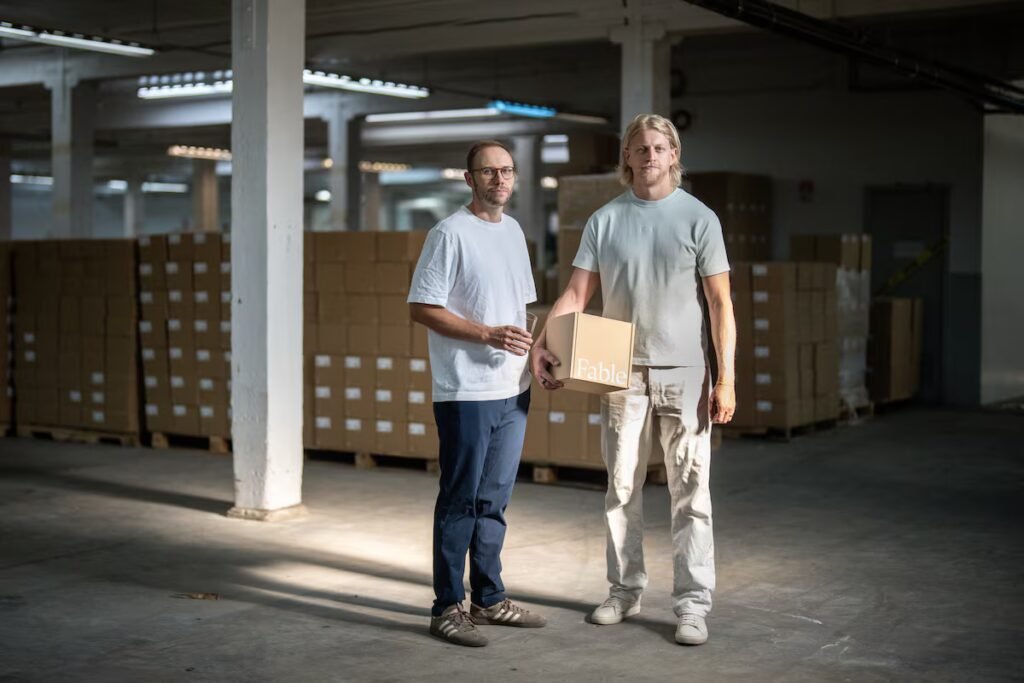

Fable Home cofounders Joe Parenteau (left) and Max Tims pictured before a pop-up warehouse sale in Vancouver, B.C., on Wednesday, August 12, 2026.Ethan Cairns/The Globe and Mail
The past six months have been eerily stable for Fable Home, the Vancouver-based direct-to-consumer dinnerware and homeware brand.
“We’ve really never been in a… I don’t want to say simple period, but a period of time where there haven’t been outside factors playing such a huge effect,” says Joe Parenteau, the company’s co-founder and chief executive officer.
The company has navigated a cascading series of crises since it was launched by Mr. Parenteau and his cofounders Max Tims and Tina Luu in 2019: It started with the spike in home goods sales during the pandemic, followed by a drop-off in home spending as people, tired of social distancing, diverted funds to travel.
The company went from skyrocketing sales to figuring out how to get people to shop for home goods, all while navigating widespread global supply chain disruptions caused by the shift in online ordering demand during the pandemic.
Then came the elimination of the de minimis exemption last year – a rule that formerly allowed Canadian businesses to ship goods valued under US$800 to the U.S. duty- and tariff-free, prompting the brand to build a warehouse stateside seemingly overnight.
Cathy Bennett, a founding and general partner at venture capital firm Sandpiper Ventures, says that the relentless run of micro-crises has helped Fable become an agile player in the North American homeware market, which Grandview Research projects will be worth around $852-billion by 2030.
“We’ve had the privilege of working with them [through] some pretty deep lows and high highs,” says Ms. Bennett, whose company helped Fable raise around $11.8-million in seed and Series A funding. “The ability for the team to, under Joe’s leadership, respond quickly, not second-guess and make a decision fast has enabled them to be very nimble.”
That agility has paid off. Over the past seven years, the company has expanded from its first run of design-centric but durably crafted tableware into rugs, lighting and art, pushed into the U.S. and the U.K., grown to 30 employees and opened two brick-and-mortar stores, one in Vancouver and another in Toronto.
The pandemic turbulence is behind it. Its U.S. fulfillment centre enables it to ship directly from overseas manufacturers. Aside from rising gas prices that are driving up freight costs, Mr. Parenteau says things are relatively calm.
But as Fable introduces new verticals, it has had to de-risk its increasingly complex supply chain and streamline internal processes. To do so, it’s leaning into artificial intelligence.
Labyrinthine supply chain
Fable’s business model is built on the intersection of design and functionality, pieces that make sense and go together – whether it’s glassware and plates or the vase in the centrepiece.
“[Consumers] want to shop with one brand to outfit their entire table,” Mr. Parenteau says.
As a certified Benefit Corporation – a designation that requires meeting stringent environmental, social and governance standards – the company knew it wanted to source goods ethically, drawing direct links between customers and the craftspeople behind the designs. Its flatware and ceramics come from makers in Portugal, the glassware is made in Japan, the rugs are woven by hand in India. The company also sources materials from the U.S. and Italy.
“Every input you add into the equation increases complexity,” Mr. Parenteau says.
It introduces new shipping routes and shipping container optimization, new packaging requirements (the breakability of ceramics and flatware requires special packaging while also preserving brand continuity) and tariffs to consider depending on whether the products pass through its Canadian or U.S. fulfillment centres.
“Not only just adding to the cost of things, but languages are different and cultural differences like how you approach problems and what good quality means,” Mr. Parenteau says. Imperfections in ceramic plates from Portugal give the product uniqueness, but flawed glassware from Japan is unacceptable.
Customers expect the same quality and packaging across Fable’s suite of products. It’s a lot to manage and Ms. Bennett says the company has started using tools such as AI to address these pain points.
“They’ve become very innovative in creating modelling that helps them do their job better and helps them see problems and make those decisions faster,” Ms. Bennett says. “[But] also take some workload off the team that doesn’t necessarily create the highest and best use for the creative folks that work with them.”
Build-your-own app
AI is also helping Fable cut costs, Mr. Parenteau says.
“Software costs have a huge impact on direct-to-consumer businesses,” he says. The software company may only charge fractions of a cent per transaction. “But that adds up to be a huge monthly fee.”
The company has recently started using Anthropic’s Claude to code its own programs. It launched a Claude-built external return platform that lets customers enter their order code and return location, then prints a shipping label.
“In the past, you’d have to have a software team develop it for you,” Mr. Parenteau. “You don’t need that anymore.”
Jason Rhinelander, head of technology and innovation at Saint Mary’s University’s David Sobey Retailing Centre in Halifax, says he’s seen many retailers, especially those that rely heavily on supply chains, such as grocery stores and home supply stores, adopt AI to rapidly develop custom software.
“The main challenge is how do they optimize the cost of paying for these platforms while at the same time figuring out how the gears connect together with their own business models?” Dr. Rhinelander says.
He anticipates a future where a company like Fable could employ agentic AI. These virtual bots work together and make autonomous decisions to manage the more complex elements of the supply chain, such as sourcing new craftspeople aligned with the business’s values or resolving packaging or quality issues before they arise.
“We’re going to get to the point where we have assistants that will actually make the entire supply chain interaction much more efficient,” he says.
In the meantime, Mr. Parenteau says that although AI has “revolutionized” how the company approaches its internal systems, it’s a tool meant to enable the team to work better.
“There are some things with AI that humans still are incredibly better at,” he says. “It allows our people to focus on those things and not the tedious, smaller things that weren’t being value-additive.”


More Stories
Four things I’ve learned about tapping into an RESP
Dominion Dynamics to build uncrewed ground vehicles for Ukraine through partnership
Boots is an iconic brand – but challenges await the Weston family