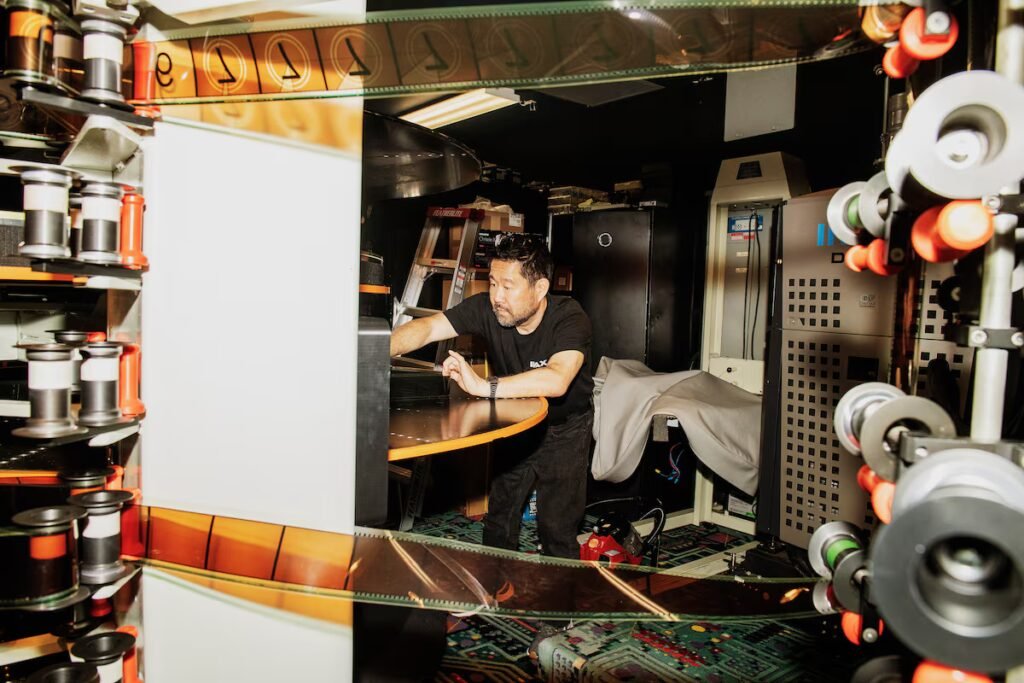

It’s nearly 11 a.m. on a weekday morning, and this 265-seat Imax theatre just north of Toronto will soon be full. But before another sold-out screening of the Christopher Nolan’s The Odyssey can begin, behind the scenes in the projection booth, a giant film strip must go on its own epic journey.
Projectionist Jyun Oki unwinds the film, which sits on a massive spinning platter, and threads it around multiple rollers, up, down and up again. It is then strung through the air, across to the projector itself, where it travels around more rollers before being threaded horizontally across the lens, repeating the trip back to be rewound on a second platter.
The film strip is so large – weighing 600 pounds, and measuring nearly 18 kilometres unfurled – that it cannot be encased in the projector. It is exposed. It looks precarious.
“There are very many hazards of scratching,” Mr. Oki says, shining a flashlight on the film. “I do a visual check. I also do a physical check. I always check to make sure it’s all good.”
The stakes are high: This single print cost roughly US$50,000. To be worth the investment, it has to be kept in peak condition, screening after screening. (The run has currently been extended to mid-September.)
This Cineplex theatre in Vaughan, Ont., is one of just nine locations in Canada showing the movie in Imax 70-millimetre film – the format on which it was shot.
It’s a hot ticket, both for film purists, and for newbies who have been drawn in by the director’s enthusiasm for Imax.
Guests enter the Imax auditorium at Cineplex Cinemas Vaughan for a showing of The Odyssey.
“I think Chris Nolan has helped Imax in a big way,” Cineplex chief executive officer Ellis Jacob said in an interview.
The Odyssey is the first feature-length film shot entirely with Imax cameras, and Mr. Nolan’s evangelism for the format has had a real financial impact. It generated the biggest opening weekend in the company’s history, with US$52-million in Imax box office revenue. That represented 20 per cent of total ticket sales.
Of that take, $6.3-million came from the 41 screens around the world that have one of these hulking film reels. (The rest are still Imax screens, but offer digital projection.)
In late July, less than a week after the opening, Imax Corp. chief executive officer Richard Gelfond raved about how Imax had been at the centre of the conversation about The Odyssey. During a conference call to discuss the company’s results, he told analysts that the film would be “transformational” for the company.
The success of the movie, he said, is “something we’ve been building toward for decades.”
An early Imax projector at Ontario Place’s Cinesphere, the first permanent Imax movie theatre, in 1971.
When Mr. Nolan fired up the hulking cameras to shoot his latest epic, he was employing made-in-Canada technology: Imax was invented by Canadians Graeme Ferguson, Robert Kerr, William Shaw and Roman Kroitor. (The company is still partly Canadian, with headquarters in Mississauga as well as New York and Los Angeles.)
In its early years, Imax screens were mostly relegated to venues such as science centres, showing short documentaries. On a trip to the Smithsonian Institution’s National Air and Space Museum in Washington in the 1990s, the American investor Richard Gelfond took his family to its Imax theatre.
He was impressed by the scope of the floor-to-ceiling and wall-to-wall screens, and the picture quality. Believing in the potential for Imax to make the jump to Hollywood blockbusters, Mr. Gelfond led a team of investors that acquired the company in 1994 for roughly US$100-million.
But building stand-alone theatres that could accommodate Imax’s massive proportions didn’t make financial sense. Instead, the company set about striking deals with movie theatre operators such as Leawood, Kan.-based AMC and Toronto’s Cineplex Inc., to include its screens in their multiplexes.
With just a handful of Canadian Imax locations equipped with 70-millimetre film projectors, tickets for the screenings are tough to get.
Those exhibitors pay to license the Imax brand, technology and equipment such as the projectors and sound systems. Imax also gets a cut of the ticket sales.
This model has helped make Imax into a global business: It now has more than 1,800 screens around the world, 43 of them in Canada. As the footprint grew, movie studios began working Imax into their release plans for big blockbusters. A major step forward came in 2009, when James Cameron’s Avatar opened in 261 Imax theatres worldwide, its biggest release at the time.
The company has continued to grow since then. The Odyssey opened on 443 screens.
Exhibitors are demanding more: In the first seven months of this year, Imax signed 62 agreements for new or upgraded systems worldwide. In the company’s second quarter, ahead of The Odyssey, Imax did its highest number of installations in a decade.
For the theatre owners – who have been increasingly investing in premium formats including Imax competitor ScreenX (owned by CJ 4DPLEX, part of South Korea’s CJ Group), and Cineplex’s own bigger-screen UltraAVX, among others – convincing audiences to pay a little extra for a ticket is a key strategy.
In addition, “audiences are becoming increasingly selective about when they go to the movies,” Mark Welton, president of global Imax theatres, wrote in an e-mail to The Globe.
“When they do go, they’re gravitating toward experiences that feel special and differentiated. That’s an important part of the conversation we’re having with exhibitors everywhere.”
Buy-in from directors has been crucial. Ryan Coogler’s best-picture Oscar nominee Sinners was filmed partly with Imax cameras. This year’s releases that did the same include Resident Evil, Street Fighter, The End of Oak Street and Denis Villeneuve’s Dune: Part Three. None has brought Imax as much attention as Mr. Nolan’s epic.
The company has already put together a presentation for studios and directors, Mr. Gelfond said, to showcase the success of The Odyssey and to make the case for them to film with Imax technology in the future.
“Avatar established Imax as a force in entertainment, accelerated our network growth around the world and permanently raised the bar for our box office,” Mr. Gelfond said. “We believe The Odyssey is also a transformational event, in many ways we can see, and many ways we can’t yet predict.”
With just a handful of Imax locations across Canada equipped with 70-millimetre film projectors, tickets for these screenings are tough to get. So tough, in fact, that among the Canadians who have not yet snagged one is Cineplex’s CEO.
“I’m telling you, it’s so hard to get a ticket,” Mr. Jacob said. He was unable to make it to the film’s New York premiere, and caught an Imax digital screening in Toronto. He prefers not to sit in the front row, the only spots available for many showings. And sure, he’s the boss – but he adds, “I don’t want to take the seat away from a patron that’s willing to pay.”
This sort of scarcity may be exactly how Imax wants it. The company’s future depends on convincing movie-theatre owners that they need to build more – and these types of sold-out screenings are an ideal selling point.
“They see filmmakers increasingly designing movies for IMAX and audiences actively seeking out the IMAX Experience, and that’s a very compelling proposition for our partners,” Imax’s Mr. Welton wrote.
Imax has estimated that its untapped market could accommodate 943 screens in North America, more than double the current total. Globally, the company believes it could expand to more than 4,400 locations.
But that almost certainly will not include many more 70-millimetre-compatible screens. For one thing, Imax hasn’t manufactured the film projectors in years. And not every release will be shot on 70-millimetre film stock, or bring in the kind of traffic needed to earn back the cost of producing such expensive prints.
Still, it is becoming more common. Projectionists like Mr. Oki – who are brought on-site only for the specialized task of screening films – have been much busier in recent years, handling buzzy releases such as Sinners, Project Hail Mary and One Battle After Another.
The Imax 70-millimetre reels must be handled carefully to avoid dust contamination or other imperfections, and projectionists must monitor the show closely from the opening scene to the final credits.
The job has its downsides. Because the film must be monitored carefully for dust particles, hair or other imperfections, projectionists cannot simply start the reel and let it run.
Mr. Oki has now watched The Odyssey, all two hours and 52 minutes, nearly 40 times. He’s memorized entire scenes of dialogue. But to him, it’s worth it.
“To get people to come back to the theatre is the main goal – and excited about film,” Mr. Oki says, as he positions his chair in front of the small window for yet another viewing. “All the younger kids, they’re coming and understanding that this was a format, back in the day, that was amazing. And you can see it on the screen.
“There’s no lie. When you look at it on screen, it’s amazing.”


More Stories
Quebec has second thoughts on oil and gas development bans
Trump names intelligence chief Jay Clayton as AI czar to head task force
Open banking a risk, and opportunity for big banks – National