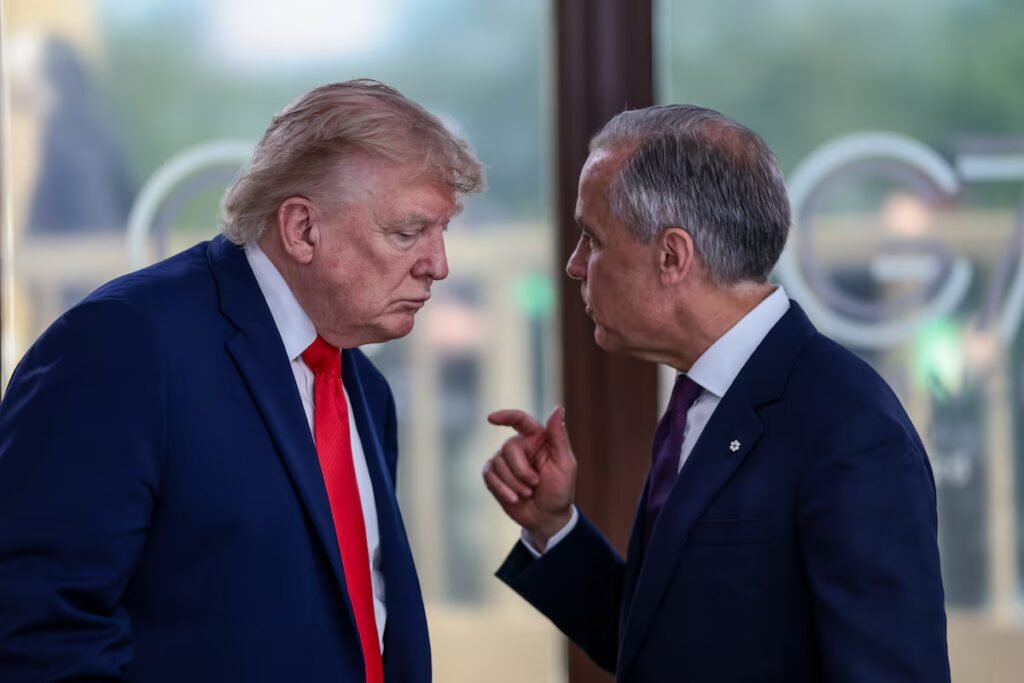

Prime Minister Mark Carney and U.S. President Donald Trump converse at the G7 summit in Evian-les-Bains, France, in June.Evelyn Hockstein/The Associated Press
John Rapley is a contributing columnist for The Globe and Mail. He is an author and academic whose books include Why Empires Fall and Twilight of the Money Gods.
In his trade negotiations with the United States, Prime Minister Mark Carney should seize the opportunity that comes with a strong hand. Because however much pain U.S. President Donald Trump can cause Canadian exporters with his tariffs, his domestic hand is very weak.
Mr. Carney holds a strong set of cards. His net approval rating among Canadians – approval minus disapproval – hovers around 20 per cent, making him the second-most popular G7 leader behind Japan’s Sanae Takaichi. (Mr. Trump’s is at -20 per cent.) With a majority government in hand, Mr. Carney’s authority is strong. Were he forced into an election he would, if current polls obtained, win in a landslide. Meanwhile Canadians are broadly united around the firm line in trade talks with the U.S. and don’t like it when the Prime Minister is seen making concessions to Mr. Trump.
As for the economy, it has so far withstood the shock of Mr. Trump’s trade war with some resilience. GDP growth isn’t great, but then nor is it in any G7 country. The U.S. economy is slowing and anyhow, its growth is something of a mirage: Take the artificial intelligence investment boom out of the equation and the U.S. economy would already be in recession – which means that when the AI bubble bursts, things could get mighty unpleasant south of the border. Reflecting this highly imbalanced economy, employment in the U.S. is flat and real wages are now declining, leaving most Americans worse off.
Andrei Sulzenko: To dance and deal with the Donald: Why the long game wins the trade war
In Canada, by contrast, the economy showed renewed signs of life in May and June, after flatlining in the first quarter. Job growth continues, if at a slow pace, and real wages remain positive, if only just. Inflation is lower, credit costs are cheaper and Canada’s stock market is actually outperforming the U.S. one. All told, the average Canadian enters this trade war in relatively better financial shape than the average American.
The weaker-than-it-appears state of the U.S. economy helps explain why Mr. Trump’s net approval rating is so bad. Nor is his unpopularity confined to the usual suspects: Many Republican voters are unhappy with his handling of the economy and especially of inflation, which they blame on tariffs and the war in Iran, both of which are his personal projects. In Republican parts of the country most hurt by Mr. Trump’s trade wars, the balance may even now be shifting toward Democrats.
And unlike Canada, whose federal government needn’t go to the polls for years, the U.S. faces a major electoral test in less than 100 days. Presently, the prospects for Mr. Trump’s Republican Party look bleak. The betting markets currently place the House of Representatives as a near certainty to go Democrat while the Senate, which would ordinarily remain Republican this year – only a third of its seats are up for grabs – has now shifted to a coin toss. Mr. Trump’s own polls keep worsening and voters cite his poor economic management as the principal reason for their disenchantment.
Put it all together and you have a popular prime minister with a mandate for tough action, even sacrifice, facing down a deeply unpopular president who enjoys no such licence and is coming under intense pressure within his own party to deliver some economic relief. With the Strait of Hormuz still closed, the U.S.’s options in the Middle East currently narrowing and gasoline prices on the rise again, Mr. Trump is not going to get a break from that quarter. He needs to deliver something closer to home, and soon.
Already beset by tariffs, Quebec braces for another big trade hit
It’s thus time for the Prime Minister to put his money where his mouth is. When earlier this year he inserted the word “rupture” into the lexicon of global politics, Mr. Carney placed Canada at the centre of an emergent world order. Politicians, academics and journalists around the world began discussing how middle powers could seize control of a global agenda in an era in which the U.S. was hastening its own decline, China was not fully stepping into the breach and Russia was exposing its fundamental fragility.
Yet while Mr. Carney diagnosed the current condition, he didn’t provide an aetiology of the disease – an explanation for how it came to be. Tempting as it might be to blame it all on one flawed, fumbling U.S. president upending the world order, a malaise that can be rectified by returning to the way things were, the world made that mistake when it assumed the Biden administration had restored sanity to world affairs.
Then Trump came back, because American voters rejected a return to old ways. The rupture is here to stay. The government has both the opportunity and the duty to lead Canada forward into a postrupture era in which the country will have to stand on its own two feet more.


More Stories
Russia to supply more than 300,000 tons of diesel to U.S. and global market, Trump says
Pitching in: Fundraising for Princess Margaret Hospital one goal at a time
Interest rates are rising. It’s not clear why. But soon something will break