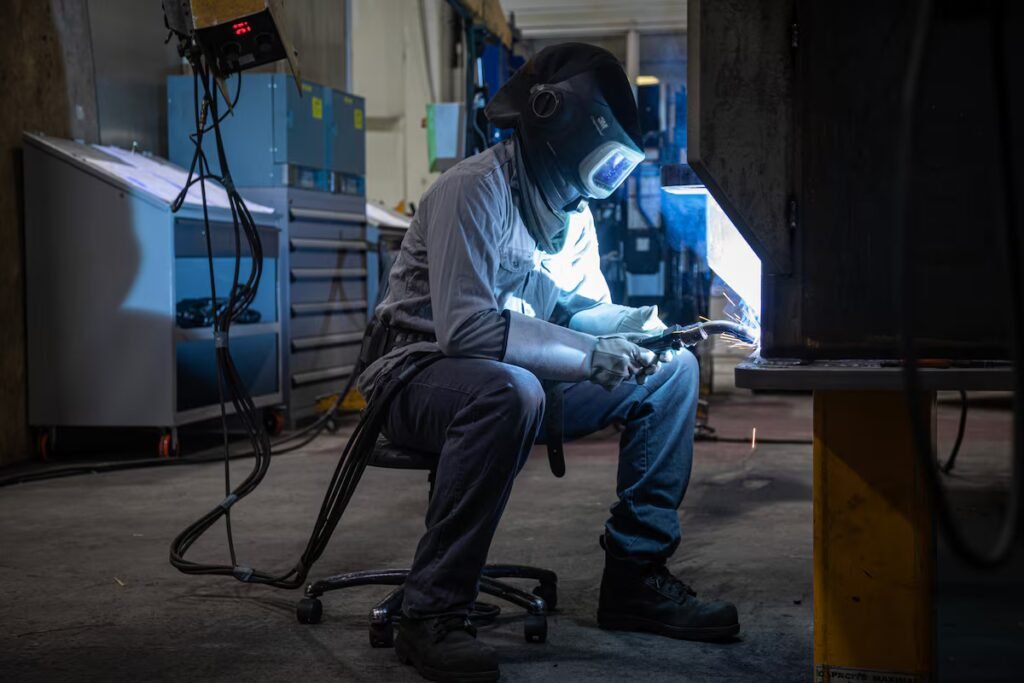

A welder at Hitachi Energy works on a tank that will contain a transformer. The company is in the early stages of an expansion intended to triple the output at its transformer manufacturing plant in Varennes, Que.Roger LeMoyne/The Globe and Mail
As expansion plans for North America’s electrical grid begin to take shape after a period of relative stagnation, few components have been more difficult to obtain than power transformers. Their availability has dwindled, to the point where utilities can wait several years to get their hands on one.
Manufacturers are scrambling to keep up: Switzerland-based Hitachi Energy HTHIY has bought land adjacent to its transformer manufacturing plant in Varennes, Que., near Montreal, and is now laying rebar and pouring concrete. It’s the early stages of an expansion intended to triple the plant’s output.
More than 30 kilometres south, in Candiac, Que., another plant is being modernized to double its production of steel utility towers. Stella-Jones SJ-T, a leading manufacturer of wood utility poles, purchased the plant last year. It’s scheduled to resume production in August.
Dreams of an electrified future – with AI data centres, next-generation nuclear reactors, and a decentralized grid fed by wind turbines and solar panels – require transformers, switchgear, poles, towers and power lines in vast quantities. But Canada’s ability to manufacture many of these items is limited.
By the federal government’s reckoning, more than half of the equipment Canadian utilities buy comes from the United States – this, during a trade war between the two countries. The U.S. federal energy department has itself complained of “insufficient manufacturing capacity to meet demand for grid transformers and component parts in the U.S.”
Prime Minister Mark Carney outlines his government’s plan to double electricity generation by 2050, a plan that includes linking provincial grids to meet increasing electricity demands driven by the spread of electric vehicles and artificial intelligence.
The Canadian Press
It’s a major obstacle as the federal government promotes a “historic buildout” of Canada’s electricity grid, in hopes that by mid-century it will carry twice as much electricity as it does today. Recognizing this, Ottawa is keen to expand domestic manufacturing. What’s happening in Varennes and Candiac reveals what’s possible – but also the limitations on how fast supply chains can respond.
The power grid consists of bulk transmission systems that move power over long distances through high-voltage power lines, and local distribution systems that deliver it at lower voltage to homes, manufacturing plants and other users.
Transformers regulate those voltage shifts, and are found in vast numbers throughout the grid. They range from huge power transformers installed in major substations, to the familiar pole-top models located in neighbourhoods across the country.
In Depth: Why a multibillion-dollar electricity infrastructure gap is threatening Ontario’s housing goals
Hitachi makes the whole gamut; its Varennes plant is dedicated to larger units, such as four it built for the recently completed Champlain Hudson Power Express, a 600-kilometre interconnection between Quebec and New York City.
The basic design of transformers hasn’t changed much in well more than a century, but there have been constant improvements with the goal of making units more efficient and compact. This matters because railways, roads and bridges can only accommodate transformers up to certain dimensions and weight.
“Our tolerances are plus or minus one millimetre,” Hitachi’s Varennes factory manager Jean-François Chouinard said.
Hitachi’s Varennes plant is dedicated to building larger transformers.Roger LeMoyne/The Globe and Mail
The manufacturing process begins with stacking the transformer’s core: workers affix razor-thin sheets of high-grade steel together into elaborate formations. In a separate area, winders make the intricate coiled assemblies that, together with the core, change voltages of electrical currents.
Hitachi can’t simply churn out identical units; its customers, which include large utilities such as Hydro-Québec and Hydro One, each have their own customized specifications, from the voltages of their networks to how many decibels of noise a transformer is allowed to produce – and thus how Hitachi will insulate its protective covering (known as the “tank”).
Transformers are essentially oven-cooked at temperatures up to 120 degrees Celsius for as long as one week, to greatly reduce the relative humidity of components. Once removed from the autoclave, a large digital clock above the plant floor starts counting. The transformer’s guts absorb ambient moisture within the plant, so final assembly must be completed quickly. This is heavy work – a tank’s plating can be thicker than an icebreaker’s hull. Dally a few extra hours, and additional moisture might cause the unit to fail high-voltage testing.
Hitachi currently ships its transformers to a nearby Hydro-Québec facility for testing, but it is building a 12,000-square-metre, $140-million test lab in Varennes. The federal and Quebec governments each contributed $30-million.
On the other side of the plant, a separate $270-million addition will house new production lines, which Carla Vicente, managing director of Hitachi Energy’s Canadian division, said will be used to nearly triple the site’s capacity to manufacture transformers.
The Varennes expansion is just one of dozens across Hitachi’s global operations.Roger LeMoyne/The Globe and Mail
A large transformer can weigh 330 tonnes – that’s before adding large volumes of oil that serve as an insulator – so the plant’s foundations require concrete up to 20 inches thick reinforced with rebar.
Finding 500 new skilled workers is equally daunting. Winders, for instance, require vast knowledge about how contaminants and humidity could degrade or ruin the product. It can take five years to master the job’s many facets.
“There’s a lot of interpretation behind it, and you have to have a very good technical mind, coupled with a certain level of craftsmanship,” said Hitachi Energy’s production manager Alex Coe. “It’s a long journey to become a master winder.”
Opinion: How infrastructure can help build Canada’s next identity
The Varennes expansion is just one of dozens across Hitachi’s global operations. It is building in the U.S. as well, investing US$457-million to expand a transformer plant in South Boston, Va., adding 825 jobs. A new plant is being constructed in Gujarat, India.
In June, Hitachi bought a long-time supplier, London, Ont.,-based Canduct Group, a 300-employee manufacturer of transformer insulation kits. Insulation often comes in the form of cardboard, but this is no ordinary cardboard. Swedish trees, which boast the purest wood fibres, are highly prized, Mr. Chouinard said. At high voltages, any impurities – such as flecks of conductive minerals or moisture – could cause shorts.
Because it’s so difficult to ship large transformers, domestic manufacturers enjoy sizeable advantages in their local markets. But with delivery times growing, Hitachi is at risk of losing more North American business to competitors, which include GE Vernova, HD Hyundai Electric and Siemens Energy.
How Hitachi will insulate a transformer’s tank, seen here in the background as a worker paints a smaller piece, is determined by its customers’ specifications.Roger LeMoyne/The Globe and Mail
But Hitachi is also not willing to spend billions of dollars to meet demand growth that may prove ephemeral. A major constraint is finding customers “actually willing to put up some money or the contracts and the frameworks to make it a bankable business case,” Andreas Schierenbeck, Hitachi Energy’s chief executive officer, said.
“Just because the government says, ‘Look, I believe I need that equipment…’ – trust me, that’s not enough to do an investment of half a billion dollars.”
Until five or six years ago, transformer plants were awash in excess capacity. Customers could receive orders within eight to 10 months. Plants were closing.
“The factories were empty,” he said. “You could barely fill a shift.”
Consequently, manufacturers are reluctant to expand today absent firm commitments for future orders from their customers. In the U.S., the Department of Energy has warned that “manufacturers are unwilling to take expansion investment risk without medium or long-term financial support and assurances.”
Said Mr. Schierenbeck: “In Varennes, we have a good customer base who has discussed what they need for the next five to 10 years or even longer, signed up the framework agreements, and then we have invested.”
A partially assembled transformer waiting to be tested. Hitachi currently ships them to a nearby Hydro-Québec facility for testing, but it is building a 12,000-square-metre, $140-million test lab in Varennes.Roger LeMoyne/The Globe and Mail
Stella-Jones faces similar constraints as it expands into manufacturing steel utility towers. Wood poles, its specialty, are rarely used for major transmission projects. But CEO Éric Vachon said that in recent years, customers began expressing interest in buying more than just treated wood products.
“Our customer said: ‘If you guys bring the same qualities to the table with steel that you do with wood, and you can leverage your footprint to distribute and help us better execute on our projects, we think it’d be a great idea.’”
Stella-Jones responded last year by buying Locweld Inc., a family-owned firm that operated the 250-employee Candiac plant, for $58-million. It immediately upgraded much of the equipment at a cost of $15-million. When the upgraded plant comes online in August, production capacity will double to 20,000 tonnes a year, and 50 more workers will be needed.
Stella-Jones has already selected a second site, in Fayetteville, Tenn., for another steel tower manufacturing plant. But order delivery times keep growing. Stella-Jones customers have visited the new Candiac plant over the past year to ensure it can manufacture to their standards.
“Our order book for 2026 and 2027 is full,” he said. “We’re selling capacity now into 2028 to 2035.”
Mr. Vachon said he’s not worried about keeping up with demand for wood poles – production for those can ramp up rapidly. But steel towers are another matter.
“Building a brand new facility on a new footprint, if I have to ballpark it, it’s probably $50-million to $60-million in investments,” Mr. Vachon said. “And the question is going to be: What is my guarantee that I’m going to get the orders to justify my investment?”


More Stories
Ottawa’s remissions system can offer some respite for companies hit by tariffs
Micron forecasts quarterly revenue, profit above estimates
It’s time to unlock billions for Canadian charities. Here’s how