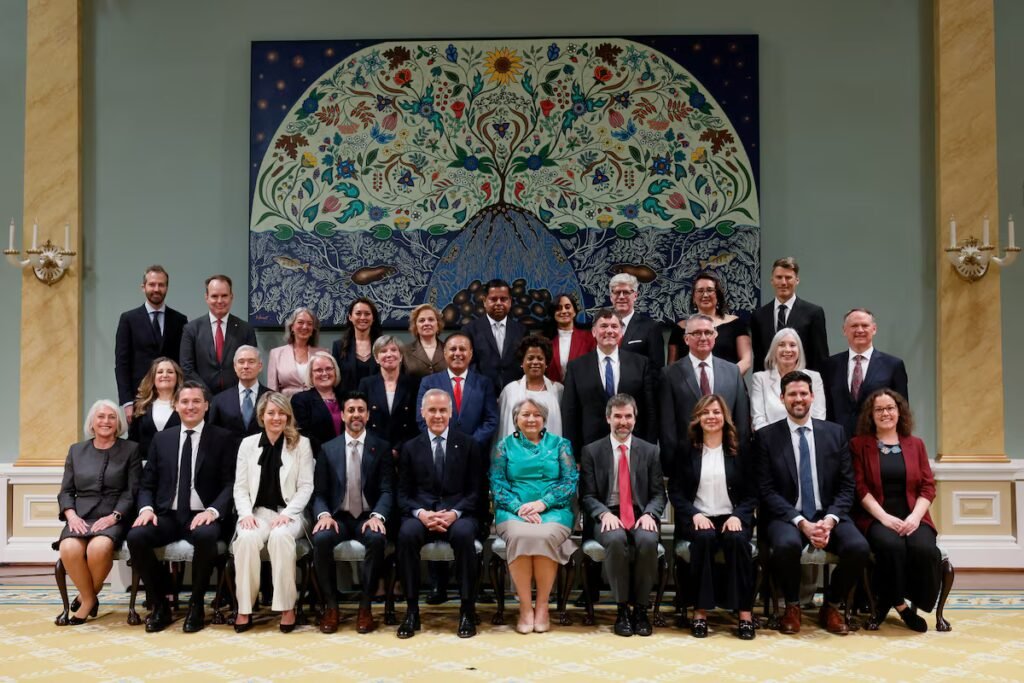

Prime Minister Mark Carney with former governor-general Mary Simon and cabinet members, at Rideau Hall, in Ottawa, in May, 2025.Blair Gable/Reuters
Paul Jenkins is a former senior deputy governor of the Bank of Canada and is an advisory board member of Magnet at Toronto Metropolitan University.
Canada faces a world of change characterized by radical uncertainty: a situation in which the future cannot be reliably predicted because of the speed and scale of change and because underlying systems themselves are shifting.
A changing world order, an AI revolution, global-security threats, climate change and erosion of democratic norms point to the need for Canada to embrace change and discard legacy strategies.
Removal of interprovincial trade barriers, unleashing a renewed spirit of entrepreneurship and enterprise, adoption of new technologies, and new funding models for postsecondary institutions are just a few examples of where principled, strategic change is needed.
Canada’s success in navigating this change will depend crucially on the collective principles our leaders across all sectors and regions bring to these challenges.
The 24 hours that could change Canada’s economic trajectory
In the aftermath of the Second World War, the Bretton Woods Institutions – including the World Bank and the International Monetary Fund – were created to govern the global economy from the perspective of the West, which represented 60 per cent of the global economy. Tensions inherent between the sovereign state and the need for collective global governance increasingly challenged this order. Effectively, a new world order began to unfold with the growth of the developing world, driven by China.
From 1948 to 2000, the global economy grew at an annual rate of nearly 4 per cent, allowing major advances in economic well-being. By early this century, a marked reversal had occurred with the developing world’s share of the global economy rising to nearly 60 per cent, giving voice to these countries.
Over these years, two other trends began to unfold: the technological revolution and large, persistent trade imbalances.
The first has accelerated in recent years because of AI. In contrast to the Industrial Revolution, this revolution has been both faster and more widespread, generating global competition and heightened uncertainty.
The second is purportedly the main rationale for the U.S. administration’s widespread, highly unpredictable, tariff policies designed to reverse their chronic trade deficits. However, U.S. tariffs are not effective, fracturing the global trading system without underlying change to U.S. savings and investment balances, and adding inflationary costs to the U.S. economy.
Campbell Clark: Making concessions to get a trade deal when the public’s in a fighting mood
On the geopolitical front, economic and security tensions are reshaping alliances, climate change is imposing both physical and financial uncertainties, and democratic institutions in many countries are under strain. Add to that war in the Middle East and in Ukraine.
What type of leadership does this changing world demand?
A central lesson from our experiences over decades – whether political, business, academic or otherwise – is that leadership is situational.
Nelson Mandela’s stand against apartheid, John Maynard Keynes’ policy insights in response to economic downturns and Alan Turing’s codebreaking during the Second World War are examples of leaders responding to situations facing them.
But situations alone cannot define the success of a leader. It is the principles a leader uses to navigate any given situation that will be the ultimate deciding factor of success.
Today we have stark contrasts in world leadership, reflecting competing principles.
U.S. President Donald Trump’s style of leadership is highly personal, confrontational and unpredictable. While Mr. Trump may view this as a demonstration of political strength, it has been a major source of instability for the global and U.S. economies.
Rita Trichur: U.S. consumers keep getting hosed by Trump’s topsy-turvy trade war
Chinese President Xi Jinping’s leadership prioritizes the principles of central control, long-term planning and state-directed national development. Mr. Xi’s approach attempts to convey the importance of stability, while subordinating individual enterprise to political authority.
These examples stand in contrast to the leadership principles of liberal democracies: constitutional government, rule of law, protection of individual rights, institutional accountability, freedom of expression and pluralism. This is a difficult balance to achieve, and when it is not, other forms of leadership become attractive.
A world of radical uncertainty elevates the importance of purpose. People look to a leader for meaning. This demands a unique set of instincts.
Leaders must be able to communicate clarity of purpose through powerful narratives. They must accept that radical uncertainty is a permanent feature, guard against a false sense of certainty, adapt without losing direction and project resilience. And leaders must understand that global uncertainties underscore the importance of realism in seeking strategic global co-operation.
What shapes these instincts in responding to uncertainty are a leader’s principles – and having a moral compass to provide consistency in following those principles. Moral leadership can also create trust: When people trust their leaders, they are more willing to tolerate the implications of uncertain times.
This amounts to Canada’s leaders, individually and collectively, communicating to Canadians through a compelling narrative a clear sense of who we are and what our interests are as an open, liberal democracy.


More Stories
Cenovus bulks up on oil sands with $5.7-billion Athabasca buy
Canada’s services PMI shows sector shrinking for fourth straight month in September
Ellison retains Thompson as CNN chief, unveils Skydance leadership team